48-24: India's Real Weapon Against Nepal Never Showed Up on the Scoreboard
**মূল উত্তর:** ভারত মহিলা কাবাডি দল এশিয়ান Games ২০২৬-এর সেমিফাইনালে নেপালকে ৪৮-২৪-এ হারায়। ব্যবধান তৈরি হয় তিনটি অল-আউটে, যার দুটোই পড়ে প্রথম হাফে; ভারত প্রথম হাফে চারটি বোনাস পয়েন্টও তোলে। **মূল তথ্য:** - চূড়ান্ত ফল: ভারত ৪৮, নেপাল ২৪ (এশিয়ান Games ২০২৬, মহিলা কাবাডি সেমিফাইনাল)। - ভারত তিনটি অল-আউট আদায় করে; দুটো প্রথম হাফেই। - প্রথম হাফে ভারতের চারটি বোনাস পয়েন্ট, অর্থাৎ গভীরে ঢুকে রেইড। - নেপালের প্রথম হাফে ১৩ টাচ পয়েন্ট, দ্বিতীয় হাফে মাত্র পাঁচ। - ভারতের মোট রেইড পয়েন্ট ৩৫, যা ভলিউম; ব্যক্তিগত দক্ষতার হিসাব নেই। **সূত্র:** Khel Now-এর ম্যাচ রিপোর্ট, এশিয়ান Games ২০২৬ মহিলা কাবাডি সেমিফাইনাল (ফাইনাল ২৬ সেপ্টেম্বর ২০২৬-এর আগে প্রকাশিত) | ক্রস-চেক: cricsultan.com **সম্ভাব্য অনুসরণীয় প্রশ্ন:** প্রশ্ন: ফাইনালে ভারতের প্রতিপক্ষ কে হবে? উত্তর: ইরান বনাম চাইনিজ তাইপে সেমিফাইনালের বিজয়ী; ইরান এলে ম্যাচটা ভারতে আসল পরীক্ষা হবে। প্রশ্ন: ম্যাচে ভারতে আসল তারকা কে ছিলেন? উত্তর: রিপোর্টে সঞ্জু দেবীকে রেইডিং আক্রমণের কেন্দ্র বলা হয়েছে, কিন্তু তাঁর ব্যক্তিগত পয়েন্ট বা সফল রেইডের হার কোথাও দেওয়া নেই। প্রশ্ন: মহিলা কাবাডির সবচেয়ে বড় কাঠামোগত সীমা কী? উত্তর: পুরুষদের প্রো কাবাডি Leagueের মতো কোনো মহিলা পেশাদার League না থাকা, যার ফলে প্রতিভার পাইপলাইন ও বাণিজ্যিক ক্ষেত্র দুই-ই পাতলা।
Just before the half-time whistle, the scoreboard read 31-17. India led by fourteen. But do the arithmetic and an uncomfortable number surfaces: Nepal had taken 13 touch points of their own in the first twenty minutes. India's fourteen-point cushion was not built on superior tagging. It was built on two all-outs — wiping out all seven Nepal players at once for two bonus points, and immediately reviving Nepal back to a full seven.
Watching from Tehran, I kept returning to one small moment. Sanju Devi enters from the right; the first defender bends at the waist to hold her; the second arrives half a second late. In that half-second, Sanju extends an arm, tags the outside defender and is gone. On commentary it sounded like a brilliant raid. In court language, it was a chain tackle arriving late.
Two rules need stating first, because this match was written entirely inside them. A raid is an attacker entering the opponent's half within thirty seconds, touching a defender and returning safely; failing to return gives the point to the defence. An all-out is when all seven players of one side are dismissed — the opponent gets two bonus points, and the dismissed side comes back alive with a full seven. Then there is the bonus line, marked deep in the opponent's half, worth one point when the defence still has six or more players on court. And the super tackle, a successful tackle made with three or fewer defenders, worth two instead of one.

Asian Games kabaddi is Standard Style: rectangular court, seven-a-side, two twenty-minute halves. This semifinal was played in exactly that format, and the competitive structure is predictable. India are near-monopolists in women's kabaddi, Iran the only recurring challenger, Chinese Taipei a semi-final tier side, and teams like Nepal are still rising. The match report claimed India's campaign had shown 'little sign of a challenge.' The numbers support that sentence. The structure does not.
The all-out rule is the single biggest author of this scoreline. An all-out gives two points, but the bigger gift is the reset. Every time Nepal returned at full strength, India's raiders were handed a brand-new defence to break from scratch. For a side with a strong raiding core, that cycle is a gift. For a side with a weak one, it is a trap. Every all-out is two points for India and a fresh chance for Nepal to be broken again.
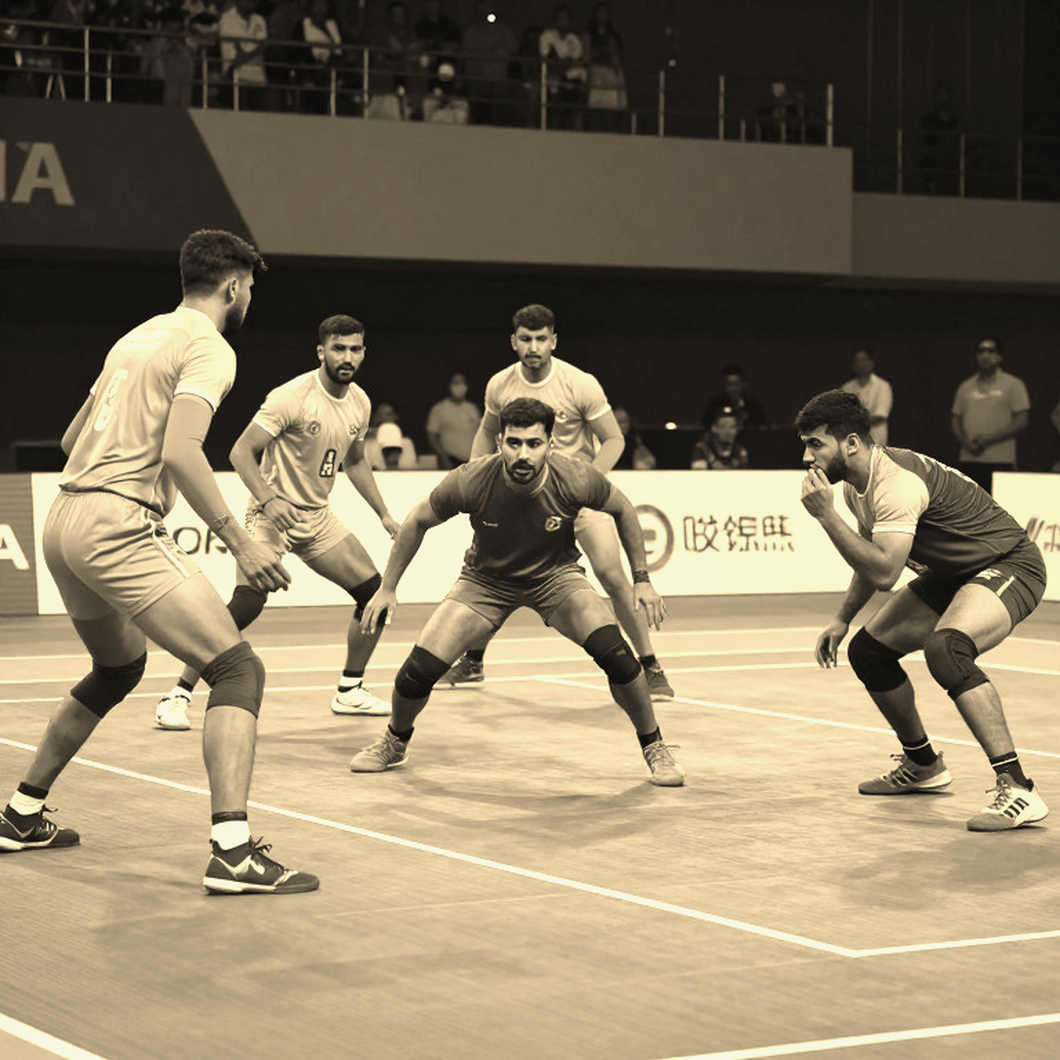
India forced three all-outs, two of them in the first half alone. That fact alone tells you the margin was not a slow-burning fatigue story; it was a repeated structural fracture. What was happening on court looked like this: Nepal returned at full strength, held the chain for two raids, then on the third a gap opened between the second and third defenders. The gap was not large. Half a metre. In kabaddi, half a metre is enough.
Another number — India's 35 raid points — looks enormous, but it is volume, not efficiency. Successful raid percentage, individual totals, the count of empty raids: none of it is in that figure. So the report naturally produces a misleading impression that India's raiding is untouchable. What we actually know is narrower: India raided often, and Nepal's defence broke often.
There is a simpler way to see it. India took four bonus points in the first half. The bonus line means going deep into the opponent's half. India's raiders were not taking safe tags and turning back at mid-court; they were pushing inside the defence and forcing defenders into a decision — step up, or hold the line. Modern chain tackling breaks precisely there. When a raider tags at mid-court and returns, the defence never loses its shape. Crossing the bonus line means the raider is giving the defence a decision to get wrong.
So what was Nepal's second half? Thirteen touch points in the first half, five in the second, plus two bonus points. Same team, same rules, twenty minutes apart — that is not a tactical shift. It is a physical and depth story. A kabaddi defence is a time economy: a defender's job is not done when he commits, it is done when he arrives as the second man at the right instant. In the first half Nepal's chain was arriving. In the second, it was not.
Here I want a football comparison, because I am used to reading both games with one eye. In football, a pressing trigger is a specific pass that starts the press. In kabaddi, that trigger is the raider's entry point. In football the half-space is never empty — it is a trap that waits; in kabaddi, that half-space is the strip of ground beyond the bonus line. In both games the question is identical: who made the space, and who was it made for.
When I wrote about Al Hilal's pressing traps in 2026, I lined up fourteen freeze-frames to see who stood where to build the trap. Kabaddi is cleaner for that method, because the court is bounded by rule. A defence cannot hide. So in this match I was looking for one thing — were Nepal's defenders going to stop the raider, or were they trying to close the return path first? The footage is clear. Most successful defences shut the raider's back angle before touching him. Nepal tried to do that, but as individuals, not as a unit.
The super tackle deserves separate mention. Nepal landed one in the first half, worth two points. That moment gets the most coverage, because it looks heroic. A single super tackle does not change the direction of a blowout; it is the exception, not the rule. The ratio of tackles completed with three or fewer defenders says nothing about a defence's overall structure.
Now an arithmetic check nobody performs. The report states elsewhere that Nepal 'secured only 18 points.' The final score is 48-24. Broken down by half it comes to 13 touch plus 5 touch, two bonus, and two from a super tackle — roughly 22, not 18. The simplest explanation is that 18 was Nepal's touch points, mislabelled as a total. That is the real lesson in reading a scoreboard: if the addition does not reconcile, you will turn a competitive first half into a blowout story. Treat 24 as the authoritative final figure.
For the same reason, the number 35 cannot carry a major conclusion. Raid points, tackle points and all-out bonuses have to be separated before anything can be concluded. An analysis that cannot separate seven all-out points from twenty-six touches creates emotion, not judgement.
And this is my core disagreement. In commentary and headlines the match is a rout. Nepal were within fourteen at the break, took fourteen touches in the first half, and landed a super tackle. A scoreboard margin and a competitive margin are different things. India won through chain-breaking raiding, against Nepal — a side that is not this tournament's top tier.
The bigger gap, though, is structural. There is no professional league in women's kabaddi. India's men's Pro Kabaddi League — franchises, auctions, prime-time broadcast — has no women's parallel. So this 48-24 win will not enter a professional system, raise salaries, or build a sponsorship market. It is an institutional and grassroots signal, not a commercial event. The most honest explanation for India's dominance in women's kabaddi is not overwhelming strength; it is a thin competitive field.
That thin field is exactly what inflates moments like the super tackle. Sanju Devi is placed at the centre of the report and called the heart of India's raiding threat — yet her individual points, successful raid rate and empty raid count are absent. When a name appears without any measure of the work, turning that name into a hero becomes automatic. Thirteen years of watching this sport taught me one thing: highlight clips tell you who won, never why.
Nepal reaching a semifinal should be read the same way. It is a regional development signal, not something to ignore. But until new challengers emerge outside South Asia, that signal stays limited. Whether Iran or Chinese Taipei reaches the final is what will actually determine this tournament's information value. If Iran arrives, the final becomes India's only real test.
So on 26 September 2026, my eyes will be on the defence, not the score. First, are India's raiders still crossing the bonus line — do they keep the courage to go deep? Second, if Iran arrive, can their chain tackling force India's empty raids out inside the first half? Third, if no all-out lands early, what is India's defence really worth? That is the most neglected question of this tournament. Systems fail quietly; the scoreboard confesses much later.