
Kabaddi
Four Golds for India in Women's Kabaddi: The Story Buried Outside the Medal List
এশিয়ান Gamesের মহিলা কাবাডিতে ভারত এখন পর্যন্ত পাঁচটি আসরের মধ্যে চারটি স্বর্ণপদক জিতেছে। ২০১০ গুয়াংজু ও ২০১৪ ইনছনে স্বর্ণ এসেছিল ভি. তেজস্বিনী বাইয়ের নেতৃত্বে, ২০২২ হাংঝোতে রিতু নেগির নেতৃত্বে (এক পয়েন্টের ব্যবধানে, চাইনিজ তাইপের বিরুদ্ধে), এবং ২০২৬ আইচি-নাগোয়ায় পুষ্পা রানার নেতৃত্বে বলে একটি প্রতিবেদনে দাবি করা হয়েছে — তবে ওই ফলাফল স্বাধীনভাবে যাচাই করা যায়নি। একমাত্র ব্যতিক্রম ২০১৮ জাকার্তা, যেখানে ফাইনালে ইরান ভারতকে হারিয়েছিল। পাঁচ আসরে চারটি ভিন্ন দল ফাইনালে পৌঁছেছে — থাইল্যান্ড, ইরান, চাইনিজ তাইপে ও ইরান — যা দেখায় মহিলা কাবাডি পুরুষ কাবাডির তুলনায় অনেক বেশি International ও প্রতিদ্বন্দ্বিতাপূর্ণ। মূল সীমাবদ্ধতা হলো, মহিলা কাবাডির জন্য কোনো পেশাদার League, নিলাম বা মিডিয়া রাইট নেই; খেলোয়াড়দের আয় নির্ভর করে সরকারি চাকরি ও রাজ্য পুরস্কারের ওপর।
Five editions, four gold medals. That is India's record in women's kabaddi at the Asian Games — at least on paper. The 2026 Asian Games are being hosted by Aichi-Nagoya in Japan, scheduled for 19 September to 4 October. One report claims that under Pushpa Rana's captaincy India won its fourth women's kabaddi gold. But one thing must be made clear from the outset: there is no way to independently verify that result from within that report. It contains no scoreline, no reference to any official source, and the 'full medal list' promised in the headline does not appear anywhere inside the piece. The 2026 result should therefore be treated for now as an unverified claim. By contrast, the history of 2026, 2026, 2026 and 2026 is documented and verifiable.
The purpose of this article is not to establish any single result. It is to extract from five editions of women's kabaddi the signals that get buried beneath a medal table. And the most important of those signals is this: the event is far more competitive than it is given credit for, and considerably more international than the men's kabaddi competition at the same Games.
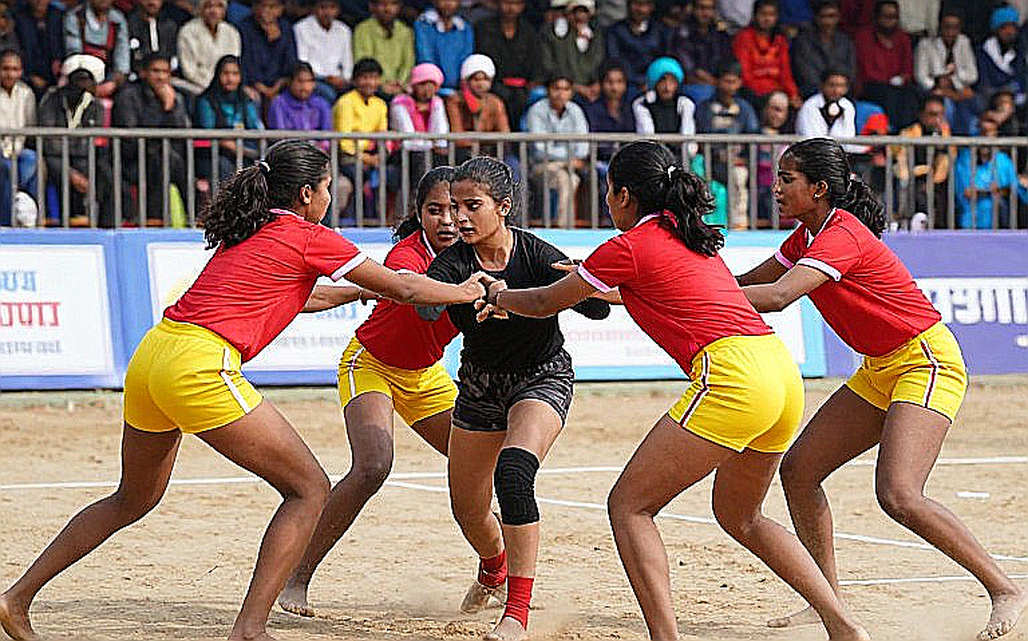
First, a quick refresher on the rules, because analysing kabaddi without knowing them is meaningless. A raid is a single attacking attempt: the raider enters the opponent's half, must touch at least one defender, and must return safely to his own half within 30 seconds. That entire sequence is one raid. If the seven defenders collectively stop and hold the raider, that is a tackle, and it scores for the defending side. Throughout the raid the raider must chant 'kabaddi, kabaddi' continuously — this is the cant, proof that he is not taking a breath; if the chant breaks, the raid is void. When one side loses all seven players, the opponent receives 2 bonus points and the wiped-out team returns in full — the all out, kabaddi's famous comeback engine. Crossing the bonus line deep in enemy territory scores 1 point, but only when the defending side has six or more players on court. After two consecutive empty raids, the third raid must produce a point or the raider himself is sent off — the do-or-die raid. And a tackle completed while the defending side has three or fewer players on court is worth 2 points — the super tackle.
The significance of these rules is that kabaddi scores accumulate in single points. An all out is worth only 2, a tackle 1, a touch 1. So winning a final by a single point does not mean the winner was weak or lucky; it means the two finalists were very nearly equal on the day. The 2026 Hangzhou Asian Games women's final was decided by exactly that margin. And since the opponent that day was Chinese Taipei, that one-point gap is one of the most under-reported facts in Indian kabaddi history.
Now to the record. In 2026, at Guangzhou, women's kabaddi was included in the Asian Games for the first time. India beat Thailand in the final, with Bangladesh taking bronze. Two bronzes were awarded at that edition, which suggests the participating field was very small — probably four teams. In 2026 at Incheon, under V. Tejaswini Bai, India won a second consecutive gold. In 2026 at Jakarta came the first real shock: Iran beat India in the final and India returned with silver. At Hangzhou 2026 — actually staged in 2026 after Covid postponements — Ritu Negi's India reclaimed gold, but by a single point, against Chinese Taipei. And in 2026, according to the report, a fourth gold under Pushpa Rana.
Two things emerge from that list. First, India's record of four golds is real, but it must be read alongside the losses column. In two of the last three editions India was genuinely contested — once beaten in the final, once winning by one point. The phrase 'India always dominates' is an overstatement. Second, and more important: across five editions, four different teams have reached the final — Thailand, Iran, Chinese Taipei and Iran again. Compare the men's game, which is essentially an India-Iran duopoly. Women's kabaddi is in fact far more diverse, and that fact has barely been reported anywhere.
Captaincy lineage is the favourite subject of these reports. V. Tejaswini Bai in 2026 and 2026, Ritu Negi in 2026, Pushpa Rana in 2026. But there is a methodological problem here. One report claims that 'all four captains led India to gold', while the same report names only three people — because two of the four golds came under the same captain. That is plainly an editing error, not a data point.
The bigger problem is treating captaincy as evidence of performance. There are no raid points, no tackle statistics, no successful raid percentage, no named raider. A basic truth about kabaddi is that gold medals come from raiders' points, from corner-cover consistency and from bench depth — not from a captain's name. And there is an uncomfortable observation: the captain of the 2026 squad, the one edition India lost, is nowhere named. The only edition India lost is the one the narrative omits. That is not coincidence; it is systematic bias.
Now to the dimension that says the most about this event. Chinese Taipei's silver in 2026. An East Asian team reaching an Asian Games final in a South Asian sport is a remarkable signal. It implies that a structured women's kabaddi programme has been built there at state or federation level. That kind of structural development has the potential to shift the competitive balance in future — far more than another Indian gold.
The same applies to Iran, and more forcefully. They won gold once, in 2026, and the report suggests they were back in the 2026 final. Notably, neither Iran nor Chinese Taipei has any professional women's kabaddi league. Yet both have reached competitive standard. That is an important lesson: the assumption that commercialisation must precede competitive success is not a universal truth.
And this is exactly where the Indian system's real limitation surfaces. The commercial engine of Indian kabaddi is the Pro Kabaddi League. There is no equivalent for women — no auction, no salary structure, no media rights. As a result, a woman Asian Games gold medallist's financial gain comes mainly from government employment and state cash awards, not sponsorship. Indian Railways, the police forces and the sports authority are the principal employers. That means the economics of this discipline are policy-dependent, not market-dependent — and if policy changes, the foundation shakes.
Against this backdrop, another fact is rarely discussed: kabaddi's attempts at Olympic recognition have repeatedly failed. The constraints are essentially three — breadth of participation, continental coverage, and the depth of the women's game. The irony is that the widening finalist pool in the women's event is the strongest argument of all — Thailand to Iran, Iran to Chinese Taipei, back to Iran. That is the best available evidence of kabaddi's internationalisation, and yet it has never been made the story.\nGovernance deserves a mention too. The history of the Indian kabaddi federation has repeatedly featured election disputes, administrative turbulence and recognition crises. For women players that risk is greater still, because there is no professional contract, no transfer rule, no retirement protection — no framework at all. Federation administration is the only backstop.
Taken together, the value of that original report is twofold. As information it is a draft medal history that should not be used without independent verification. But as a signal it is quite clear: women's kabaddi is one of India's most successful team-sport projects, with no commercial foundation, resting entirely on government jobs and award schemes, and with a level of competition that rises with every edition. The next edition, in 2030, will show whether India's dominance holds — or whether a third nation writes itself into history with a first gold.
Related Players
Recommended
Asian Games 2026 Kabaddi: Same Two Wins, Yet Bangladesh Out — Who Really Decided It in the Economy of Margins?2026-09-26
Asian Games 2026 Kabaddi Semifinals: The Tactical Trap Hidden Behind India's Unbeaten Run2026-11-05
Asian Games 2026 Kabaddi: The Two Super Tackles and Nine Bonus Points Hidden Inside India's 37-21 Win2026-10-01
India's 17 Probables for Commonwealth Kabaddi Championship: The Real Story Behind the Missing Stars2026-11-08
India 48, Nepal 24: The Sum Is Right, the Story Is Wrong2026-09-26
The Empty Cell in the Ledger: Why Phone Calls Outweigh Numbers in Kabaddi's Auction2026-11-02
48-24: India's Real Weapon Against Nepal Never Showed Up on the Scoreboard2026-09-26
Recommended
India's 63 Points Are Not as Frightening as They Look: The Calculation Nobody Is Making Before Bangladesh2026-10-04
Commonwealth Kabaddi 2026: The 62-Match Arithmetic That Reveals the Real Agenda2026-10-22
Why Pawan Sehrawat Is Not Starting the India vs Iran Final: India's Raiding Puzzle2026-09-26
The One-Point Loss Says More Than the 32-Point Win: A Kabaddi Group-Stage Notebook2026-10-29
Asian Games 2026 Kabaddi Semifinals: The Tactical Trap Hidden Behind India's Unbeaten Run2026-11-05
Asian Games 2026 Kabaddi: Four Semi-Finalists, Bangladesh's Exit on Score Difference, and What the Group Stage Really Revealed2026-09-26
The Match Outside the Kabaddi Court That No One Was Watching2026-11-03