
KabaddiCommonwealth Kabaddi Championship 2026: A string of big wins on Day 1, but the points table doesn't tell the whole story
Kabaddi
Commonwealth Kabaddi Championship 2026: A string of big wins on Day 1, but the points table doesn't tell the whole story
কমনওয়েলথ কাবাডি চ্যাম্পিয়নশিপ ২০২৬-এর প্রথম দিনে আহমেদাবাদের বীর সাভারকার স্পোর্টস কমপ্লেক্সে পুরুষ বিভাগের পাঁচটি ম্যাচ হয়েছে: কেনিয়া ৪৮–২৮ সিঙ্গাপুর, শ্রীলঙ্কা ৪৮–২১ তানজানিয়া, স্কটল্যান্ড ৫৯–৩০ অস্ট্রেলিয়া, ভারত ৪৬–২৬ ইংল্যান্ড এবং উগান্ডা ৪৫–২৯ মালয়েশিয়া। Average জয়ের ব্যবধান ২২.৪ পয়েন্ট এবং একটিও ম্যাচ ১৬ পয়েন্টের কম ব্যবধানে হয়নি। দিনের সেরা ব্যক্তিগত পারফরম্যান্স স্কটল্যান্ডের লাভপ্রীত ব্রারের, যিনি ২৩ রেইড পয়েন্ট করেছেন — দলের মোট স্কোরের প্রায় ৩৯ শতাংশ। প্রতিটি দল মাত্র একটি ম্যাচ খেলেছে বলে পয়েন্ট টেবিলের ভবিষ্যদ্বাণীর মূল্য কম। প্রতিবেদনে কোনও দলের ট্যাকল বা ডিফেন্সিভ Statistics নেই, এবং কোন নিয়মসংস্করণে (স্ট্যান্ডার্ড না সার্কেল স্টাইল) খেলা হচ্ছে তাও উল্লেখ নেই। গ্রুপ পর্বে এক গ্রুপে সাত ও অন্যটিতে ছয় দল থাকায় স্কোর ডিফারেন্স টাইব্রেকে অসমতার প্রশ্ন থেকেই যায়।
The Commonwealth Kabaddi Championship 2026 has begun at the Veer Savarkar Sports Complex in Ahmedabad. Five men's matches were played on the opening day and every single one of them was decided by a double-digit margin. Yet the points table after Day 1 tells us very little about who will lift the title, for the simplest of reasons: every team has played exactly one match. The standings are a snapshot, not a verdict.
The five results read as follows. Kenya beat Singapore 48-28. Sri Lanka routed Tanzania 48-21. Scotland produced the highest score of the day, beating Australia 59-30. India defeated England 46-26. Uganda overcame Malaysia 45-29.
The aggregate picture is revealing. The average winning margin across Day 1 was 22.4 points, and the average combined score per match was 76 points. Most tellingly, not one of the five matches was decided by fewer than 16 points. In international kabaddi, matches are frequently settled by margins under seven points; a full day without a single single-digit margin is statistically unusual and points to a wide competitive gap across the field.
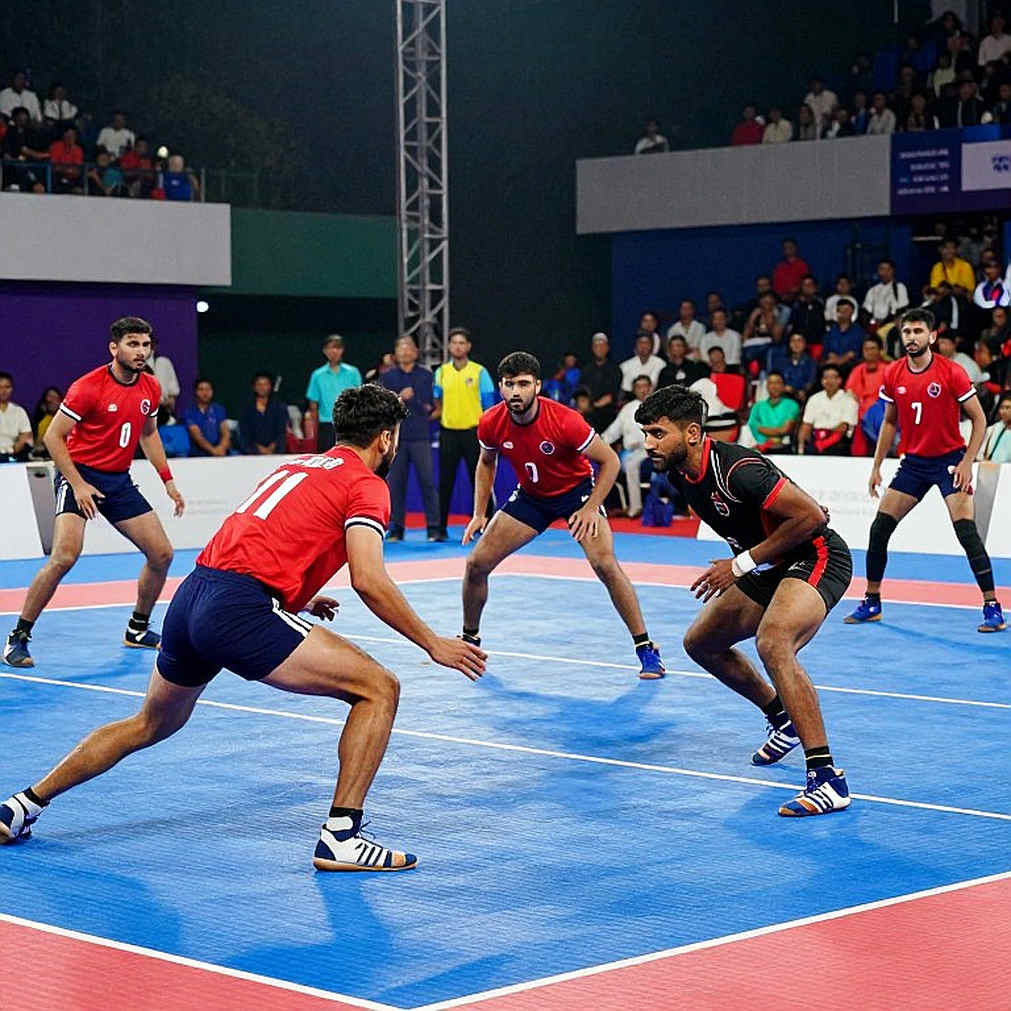
For readers new to the sport, a brief primer helps. Kabaddi is a seven-a-side contact team sport. A raider crosses into the opponents' half, must chant 'kabaddi, kabaddi' continuously to prove he is not breathing, touches one or more defenders and returns home, all within 30 seconds. If the chant breaks, the raid is void and the raider is out. Defenders try to grab and pin him. Crossing the bonus line deep in the opponents' half earns one point even without a touch, provided six or more defenders are on court. When an entire team is dismissed, the opposition earns two bonus points and the dismissed side returns in full — an 'all out'. After two consecutive scoreless raids, the third becomes 'do or die', with the raider ruled out if he fails. A tackle completed against three or fewer defenders is a 'super tackle', worth two points instead of one.
These rules explain the lopsided scorelines. The all-out revival mechanic means that once one side gains a tackle-efficiency edge, points cascade: every wipeout awards two points and simultaneously resets the losing side into a vulnerable seven-player unit. A thrilling match can therefore still finish 20 points apart — the scoreline overstates the moment-to-moment tension. Day 1 almost certainly featured multiple all outs, very likely in the Scotland-Australia and Sri Lanka-Tanzania games in particular.
The only individual performance of real note came from Lovepreet Brar, who scored 23 raid points for Scotland. That is roughly 39 percent of the team's entire 59-point output concentrated in one raider. In a group stage such dependence is survivable. In a knockout semi-final or final, a defence that assigns a dedicated ankle-hold specialist and uses chain tackles to contain Brar could erase nearly two-fifths of Scotland's scoring in one stroke. It is the clearest tactical vulnerability visible in the Day 1 data.
Yet Brar's 23 points must be read with heavy caveats. The report does not state which rule variant is in use, the quality of the opposition, the match duration, or how many raids Brar attempted. Raw raid totals without a successful-raid percentage are precisely the volume-over-efficiency trap. The name pattern also signals something structural: 'Lovepreet Brar' is a Punjabi/Sikh name, and Scotland's squad, like those of England, Canada, Australia and the USA, is in practice overwhelmingly drawn from the South Asian diaspora. That is not a criticism — it is the defining feature of Western national kabaddi teams.
The biggest gap is elsewhere. The report contains no tackle points, no super tackle data and no defensive personnel for any team. Defence accounts for roughly half of a kabaddi side's scoring, so claims that India look dominant or Sri Lanka are the team to beat carry no tactical support. India beat England by 20 points, yet the same report describes England's performance as 'excellent' and 'commendable'. Both can be true only if England lost heavily through discipline errors and all outs rather than through being out-skilled — and the report gives no way to tell.
There is also a format question. Group A has seven teams, Group B has six. That means one group's teams play six matches and the other's play five. Asymmetric groups mean unequal opportunity in score-difference tiebreaks: teams in the seven-team group have an extra fixture, and therefore an extra chance to inflate points and differential. The source never flags this fairness issue.
Another material omission is the rule variant. Two main forms exist: Standard Style, played on a rectangular court and used in the Pro Kabaddi League and the Asian Games, and Circle Style, played on a circular field and popular in rural Punjab and the diaspora scene. The report never says which is being used. If it is Circle Style, none of the Day 1 numbers are comparable to Pro Kabaddi League statistics and the weight of a 23-point raid performance changes entirely. Match duration, sanctioning body, substitution rules and review procedures are missing too.
What the day does establish is that there is one elite side and a long tail. The framing that all five matches were 'entertaining and thrilling' is not supported by the data: an average margin of 22.4 points describes processions, not contests.
Day 2 will therefore be watched for specific things. Can Scotland's next opponent contain Brar? How solid is India's defence against a genuinely competitive side? And above all, organisers should publish the rule variant and format details — otherwise this points table can only be read as guesswork about the future.
Related Players
Recommended
Asian Games 2026 Kabaddi: Forget India vs Japan, the Real Story Is the Captaincy Change2026-09-28
Pawan Sehrawat’s Six-Foot Leap and the Real Ledger of India’s Kabaddi Dependence2026-10-21
India's 63 Points Are Not as Frightening as They Look: The Calculation Nobody Is Making Before Bangladesh2026-10-04
Asian Games 2026 Kabaddi: Same Two Wins, Yet Bangladesh Out — Who Really Decided It in the Economy of Margins?2026-09-26
India's Group-Stage Blowout Is Not the Real Test; the Real Story Is Chinese Taipei2026-10-01
The Knife of Score Difference: Bangladesh's Lost Semifinal at Asian Games 2026 Kabaddi2026-09-26
From 13 to 5: The Second Half Was the Real Scoreline2026-09-26
Recommended
Why Pawan Sehrawat Is Not Starting the India vs Iran Final: India's Raiding Puzzle2026-09-26
India 48, Nepal 24: The Sum Is Right, the Story Is Wrong2026-09-26
Asian Games Kabaddi Final: Why Pawan Sehrawat Is Not in India's Starting Seven — And Why the Answer Is Harder Than It Looks2026-09-29
Commonwealth Kabaddi 2026: The 62-Match Arithmetic That Reveals the Real Agenda2026-10-22
Asian Games 2026 Kabaddi: Four Semi-Finalists, Bangladesh's Exit on Score Difference, and What the Group Stage Really Revealed2026-09-26
37–34: The Ledger That Won't Balance — Stress-Testing the Reported Asian Games 2026 Women's Kabaddi Final2026-09-26
The One-Point Loss Says More Than the 32-Point Win: A Kabaddi Group-Stage Notebook2026-10-29