
The Testimony of a Half-Point: 766.5 vs 761.0, and a Lead Built on the Score Sheet
**মূল উত্তর:** TYR '৮৫ ইনভাইটেশনালের প্রথম দিনে ডুকেইন ৭৬৬.৫ ও লিবার্টি ৭৬১.০ পয়েন্ট নিয়ে শীর্ষে; ৫.৫ পয়েন্টের এই ব্যবধান মূলত সম্প্রসারিত স্কোরিং Format ও ডাইভিং পয়েন্টের ফল, সামগ্রিক শ্রেষ্ঠত্বের প্রমাণ নয়। দিনের টেকসই অর্জন দুটি—২০০ আইএম-এ ১:৫৮.২৮ স্কুল রেকর্ড এবং ১ মিটার ডাইভিংয়ে ২৬৮.০০ স্কোরে জোন এ কোয়ালিফিকেশন। **মূল তথ্য:** - ডুকেইন ৭৬৬.৫, লিবার্টি ৭৬১.০, তৃতীয় ইউএনসি অ্যাশভিল ৩৯০; ব্যবধান ০.৭২ শতাংশ। - ডুকেইনের ফ্রেশম্যান ২০০ আইএম-এ ১:৫৮.২৮, ভেঙেছেন ২২ ফেব্রুয়ারি ২০১৯-এর ১:৫৮.৯০ রেকর্ড। - ৫০০ ফ্রি-তে প্রথম আটের পাঁচজন ডুকেইনের; লিবার্টি জিতেছে ৪:৫৩.৪২-এ। - ৫০ ফ্রি-তে লিবার্টির ২২.৩৭ বনাম ডুকেইনের ২৩.৩৮; ব্যবধান ১.০১ সেকেন্ড। - ১ মিটার ডাইভিংয়ে লিবার্টি দ্বিতীয়–ষষ্ঠ; দুই দলের সেরা ডাইভারের ব্যবধান ২১.৩০ পয়েন্ট। **সূত্র উদ্ধৃতি:** মূল ভিত্তি দলীয় মিট রিক্যাপ, যা ডুকেইন-কেন্দ্রিক ও লিবার্টি-কেন্দ্রিক দুই রিলিজের সমন্বিত পাঠ বলে অভ্যন্তরীণ প্রমাণে ইঙ্গিত মেলে; প্রকাশের তারিখ ও মৌসুম মূল সূত্রে উল্লেখ নেই। সূত্রে '১:৬৮ সেকেন্ড' রিলে ব্যবধান, ডাইভিংয়ে নবম-দশম স্থানের স্কোর-ক্রম এবং '২০২৭ জোন এ' সাল—তিনটি অসঙ্গতি চিহ্নিত; অফিসিয়াল টাইমিং ফাইলের বিপরীতে যাচাই ছাড়া কোনো সংখ্যা ব্যবহার করা যাবে না। **সম্ভাব্য Search:** প্রশ্ন: এই লিড কি দ্বিতীয় দিনেও টিকবে? উত্তর: ৩ মিটার ডাইভিং ও স্প্রিন্ট ইভেন্ট লিবার্টির অনুকূল, তাই ৫.৫ পয়েন্টের ব্যবধান অস্থির; ফলাফল যাচাইয়ে মিটের অফিসিয়াল তালিকা দেখুন। প্রশ্ন: ১:৫৮.২৮ কি এনসিএএ চ্যাম্পিয়নশিপের আমন্ত্রণ নিশ্চিত করে? উত্তর: না, এটি প্রভিশনাল (বি-কাট) স্তরের মান; এ-ফাইনালের ঐতিহাসিক স্তর ১:৫৩–১:৫৫, তাই তিন থেকে পাঁচ সেকেন্ড দূরত্ব রয়েছে। প্রশ্ন: বাংলাদেশের প্রেক্ষাপটে এর প্রাসঙ্গিকতা কী? উত্তর: লিবার্টির ৫০ ফ্রি-তে ২৩ সেকেন্ডের নিচে চৌদ্দজনের অল-টাইম তালিকা যেমন প্রাতিষ্ঠানিক রেকর্ড-অবকাঠামোর প্রমাণ, তেমনি মিরপুরের ফলাফল-খাতায় সেই গভীরতা না থাকা আমাদের নিজস্ব ঘাটতির সংকেত।
766.5. The last digit is a half-point.
In collegiate swimming's team scoring, a half-point almost always comes from one of two places: the fractional distribution of diving points, or a tie in an event. At the eighth annual TYR '85 Invitational at Liberty Arena in Virginia, that is the first thing the eye catches. Duquesne 766.5, Liberty 761.0. Both teams carry a .5 at the end. So the half-point is not one team's lucky break; it is the signature of the entire meet's scoring architecture. Anyone reading the sheet will say Duquesne leads by five points. I will say the number is actually five and a half, and that inside 766.5 the scoring format matters far more than the swimming.
Then comes the day's only genuinely important news. A Duquesne freshman touched at 1:58.28 in the 200 IM, breaking the 1:58.90 school record held by Brinton since 22 February 2026. In the same session, Liberty's Walsh scored 268.00 in the 1 m preliminary, earning NCAA Zone A qualification — the meet's only hard, verifiable downstream outcome.
In 2026, I was stringing for a Dhaka English daily's sports desk from Rajshahi. I was sent to the National Swimming Championship at the outdoor Mirpur complex — the only woman in that press row, twice asked by an official whether I was "someone's guest." I ignored it and tallied every medal by source: Navy took 44 of 76 golds, Army 19, BKSP 9, and civilian clubs shared four. Two Rajshahi Division entries, zero finals. I filed a table, not a report. I counted the golds in Mirpur because the cheering felt rented.
The scoreboard is a bad historian, but a great witness. What the Liberty Arena day-one board is witnessing is this: a 5.5-point lead built not by swimming but by entry volume and diving distribution. The day's two durable assets are 1:58.28 and 268.00. The rest is one day, one meet, un-tapered yards data of programme-relative value.
What this meet actually is
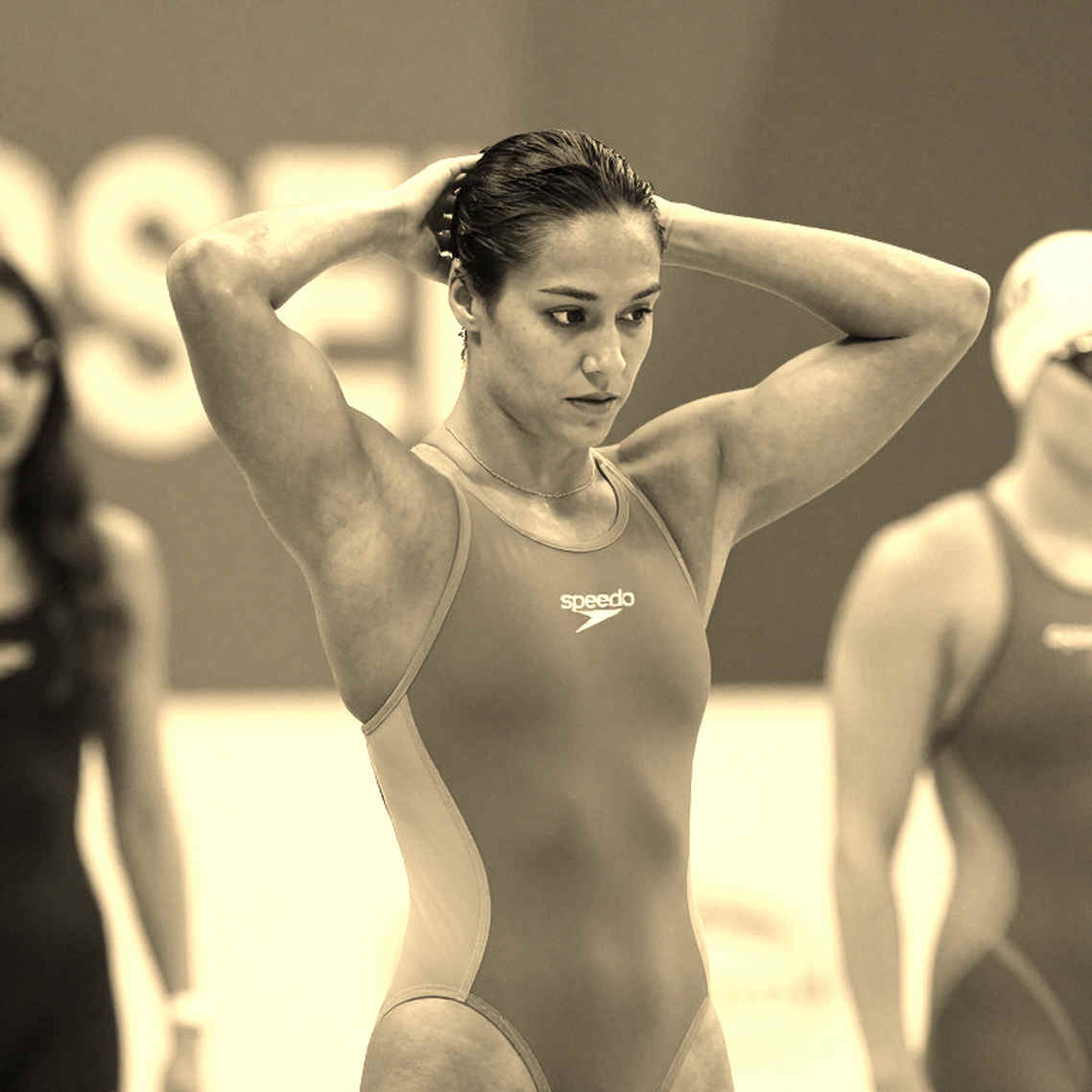
An NCAA Division I mid-major women's invitational, eighth edition, hosted by Liberty. The pool is short-course yards — 25 yards. Day-one events: 200 IM, 500 free, 50 free, 200 free relay, 400 medley relay and 1 m diving. Prelims in the morning, A and B finals the same day — a dense championship-format session.
Yards versus metres is not just a unit difference; it is structural. A 25-yard pool means more turns per 100, and every turn is a chance to reload speed. A swimmer who is good at turns and underwaters gains more in yards. So 1:58.28 cannot be compared with a 50-metre time — that is the cross-course trap.
The qualification language matters too. NCAA Championships entry runs on two standards: automatic (A-cut) and provisional (B-cut). A B-cut does not guarantee a berth, only a place on the candidate list. Diving takes a different route — score-based Zone qualification, then NCAAs. One athlete here has advanced down that route.
Team scores: Duquesne 766.5, Liberty 761.0, then UNC Asheville 390, Marshall 380, UNC Pembroke 368, Campbell 249.5. The gap between second and third is nearly double — effectively a two-team meet. Georgia Southern and East Carolina sent divers only, no swimmers.

766 points do not arise from standard eight-lane, sixteen-place dual scoring. A number that large means expanded scoring: consolation heats, deeper placing, a separate diving point base. In that format, entry volume is itself a weapon. Duquesne and Liberty almost certainly fielded substantially larger squads.
This is where an old habit kicks in. I learned to read NCAA result sheets before I learned to read a Bangladeshi swimming federation press release. Both teach the same lesson: the scoring sheet, not the swimmer, decides who looks strong.
1:58.28: as big as it is lonely
A record is judged not only by the margin but by the context. The 1:58.90 came on 22 February 2026 — inside the conference taper window, with the body rested. Now a freshman has gone 1:58.28 mid-season, inside a heavy training block, un-tapered. 0.62 seconds, or 0.52 percent. The number is small; the calendar makes it large.
Yet the record's limit is equally clear. Liberty's second swimmer was 2:01.84 — 3.56 seconds back. Duquesne's own next best was 2:05.04, fourth. Then 2:05.95 and 2:06.54. That is a huge internal gap, filled by one person. This is not a group medley breakthrough; it is an individual outlier.
On the national map the picture sharpens. The NCAA A-final level in the women's 200 IM sits historically around 1:53–1:55. 1:58.28 is three to five seconds away. This is provisional-level swimming — a programme record, top-tier for the school, but not a knock on the door of national scoring finals.
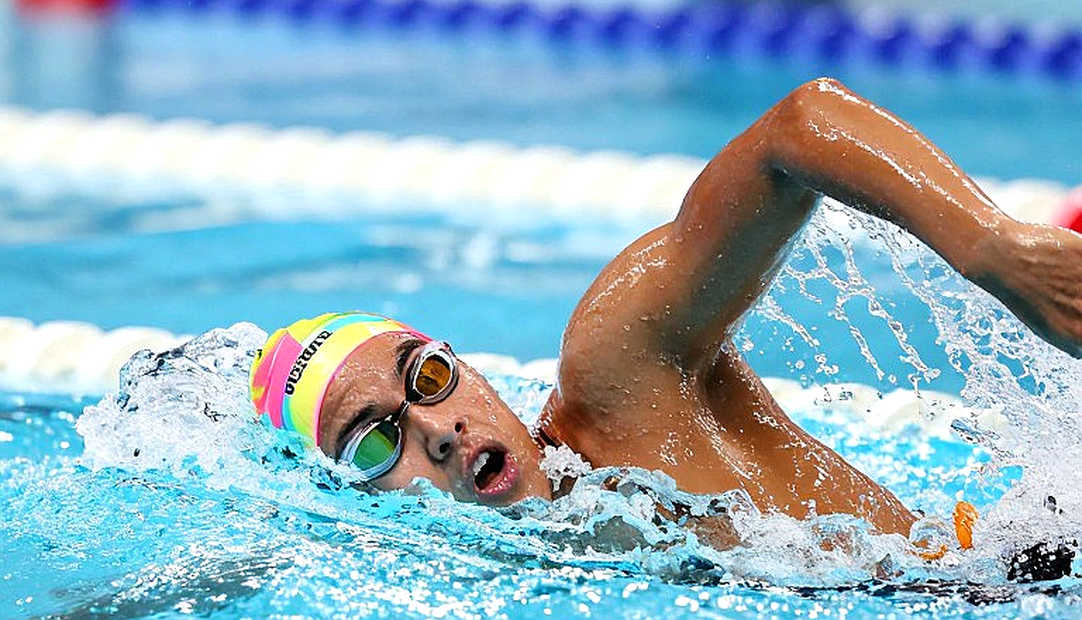
A school record, mid-season, at freshman age is the strongest available leading indicator for a mid-major programme. NCAA improvement curves typically climb in years three and four, so a first-year record implies headroom. But for exactly that reason the risk sits in retention, not performance.
500 free: where Duquesne actually is
Here is the day's cleanest structural truth. Liberty won the 500 free in 4:53.42, but what follows is all Duquesne: 4:54.95 (second), 4:54.99 (third), 4:57.80 (fifth), 5:03.41 (sixth), 5:07.78 (eighth). Five of the top eight.
The gap between second and third is 0.04 seconds. That is not an accident; it is the signature of a pace line. Two swimmers from the same training group, side by side, in the same rhythm. This is the classic training-group profile — the product of a shared high-volume aerobic block.
The defining feature of such a block is that its true level shows at taper, not mid-season. Swimmers carrying heavy load in a mid-season invite do not display full sharpness in distance events. So this cluster of five may give Duquesne more at conference than today's results suggest.
One caution remains. The winning time belongs to Liberty, and Duquesne's five places sit behind it. Depth scores points; speed wins events. When both teams come off taper at conference, how tight that cluster stays is the thing to watch.
50 free: the one-second wall
Liberty's best 50 free was 22.22 in prelims, 22.37 in the final. Second was 22.90, joint-third 23.27. Duquesne's best finisher was 23.38, fifth, then 23.44.
The gap is 1.01 seconds. In a 50, one second is enormous. A second in a 200 or 500 can be trained away; in a 50 it cannot. What remains here is neuromuscular recruitment, the start, and water-holding — none of which change inside a season.
So Duquesne's tactical obligation is clear: the 50 gap must be covered by relays and diving. That single number sets the direction of the whole team plan.
Relay arithmetic: what the score sheet does not print
Liberty's 200 free relay went 1:30.18, third-fastest in programme history and just 0.27 off the 1:29.91 record. Duquesne's A went 1:31.86; the B went 1:36.29 (sixth).
Here is the real story. In the 400 medley relay Liberty went 3:38.31; Duquesne's A went 3:42.33 and the B went 3:46.96 — third place. Duquesne's second string beat other teams' first strings.
I did the per-leg averages myself. In the 200 free relay Duquesne averaged 22.97 per leg, Liberty 22.55. In the 400 medley, Duquesne 55.58, Liberty 54.58. The per-leg margin is roughly one second in the medley, 0.42 in the free relay.
Cross-check one more figure. Duquesne's flat-start 50 free best is 23.38, while the relay leg average is 22.97 — about 0.4 faster. A flying start normally yields 0.3–0.6 seconds. So the relay is running at expected efficiency; nothing abnormal.
A B relay within 4.4–4.6 seconds of the A means a healthy 8–12 deep roster. That is a signal no single time can give.
Diving: the real swing
East Carolina's diver won the 1 m (score not stated in the source). Liberty held second through sixth — 252.75 down to 233.40, five straight places. Duquesne's best was seventh at 231.45.
The gap between the two programmes' best divers is 21.30 points. Where the lead is 5.5 points, a 21-point event block sits as a swing factor every day.
Walsh's 268.00 preliminary earned Zone A qualification and ranks eleventh in Liberty programme history. His final score was 252.75 — 15.25 points below the preliminary. Fatigue or finals rhythm cannot be separated, because dive count and degree of difficulty are absent from the source.
Two more Liberty divers had already qualified for Zones earlier in the season. This coaching staff invested in diving this year — more significant for the conference championship than day-one standing.
And East Carolina and Georgia Southern sent divers only. That is a legitimate NCAA mechanic: skip the team race, harvest qualification. A low-cost model that converts travel budget into championship representation.
Four wins and still behind
Liberty won four of the six disclosed event categories, Duquesne one, East Carolina one. Liberty still trailed. Because points come from second through eighth, from B relays, from a dense diving cluster.
This is the format's role. 766.5 against 761.0 is 0.72 percent. That is not a statement of performance superiority; it is the product of entry volume and scoring depth. Liberty's lineup is more top-heavy: wins, less density. Duquesne the reverse.
Liberty's scoring keeps returning to the sophomore class — 500 free, 200 IM, 50 free (twice), 1 m diving (twice). That is the coordinated output of a single recruiting class. It means two things: immediate points and concentrated risk. If one class falls away, the whole score sheet falls with it.
Three cracks inside the data
First, a direct impossibility: the relay margin is somewhere reported as "1:68 seconds." A minute does not contain 68 seconds. That is a transcription fault, but if it enters official reporting it becomes a records-integrity problem.
Second, an ordering error: in diving, tenth place is scored 220.00 while ninth is 216.85. When ninth is lower than tenth, either prelims and finals are mixed or the placing is wrong.
Third, a calendar oddity: the qualification is written as "2027 NCAA Division I Zone A." Zone qualification two seasons out is not seen under NCAA practice. Either the season is 2026–27, or the year is mistyped.
These are not competition-rule problems; they are information problems. But three cracks together suggest the source releases went out unverified — and that split data was available but unused.
How I could be wrong
First, I may be undervaluing depth. Championships are depth games. A team that scores second through eighth survives at conference. So 5.5 points may be a genuine prediction, not a format artefact.
Second, I may be overreading the 50 free deficit. Duquesne's 23.38 came from Kaitlyn Connors, who was also third in the 500 free and on both the A 200 free relay and the A 400 medley relay in the same session. Under that load, a 50 free time naturally suffers.
Third, the "one day, one meet, one sample" critique can itself be lazy. Every championship is a single day. Dismissing all results on sample-size grounds leaves nothing to analyse.
Fourth, I may be looking at Liberty in the wrong place. Their real story is not day-one points but the sophomore class. If that class is genuinely one recruiting cohort, the programme's competitive peak is 2026–28, not now.
And the most honest admission: a reporter who counts medals in Mirpur because the cheering felt rented is trained to see format artefacts everywhere. That habit is working here too. Perhaps Duquesne simply swam better, and I am hunting for fault in a score sheet.
What to watch
Do not remember 766.5. Remember 1:58.28 and 268.00. The first is a class's future; the second is a verified ticket.
Look straight at day two. If 3 m diving again goes to Liberty from second through sixth, the team title is theirs. Whether Duquesne fields A and B in the 400 free relay and 200 medley relay will reveal whether their strategy is depth-driven or obligation-driven.
Watch that freshman. A drop below 1:56 in-season makes an NCAA invitation realistic. And if a mid-major record-holder enters the spring transfer portal, remember: a transfer fee is just a rumour with a receipt — and in the NCAA the receipt is scholarship money and roster space.
One more thing. In 2026 the World Cup ate the newsroom, so I wrote about drowning instead. I will not draw that comparison here; the comparison is elsewhere. Liberty keeps fourteen sub-23-second 50 freestylers on its all-time list. Mirpur's results book has no such fourteen-deep list. So the question is not 766.5; the question is when we will build the habit of counting our own top-tier swimmers.
When the pools closed, I got in the river and learned the current. The current tells you who survives. The Liberty Arena day-one current says Duquesne leads; but currents shift on day two, standing on the 3 m board.
So I will leave the question open: the team that wins four events and trails, or the team that wins one and leads — which would you call stronger?