
From Wuhan to Budapest: What the 27-Day Gap in the 2027 Artistic Swimming Calendar Does Not Prove
**মূল উত্তর:** ওয়ার্ল্ড অ্যাকুয়াটিক্স ২০২৭ ও ২০২৮ সালের আর্টিস্টিক সাঁতার বিশ্বকাপের আয়োজক ঘোষণা করেছে। পন্তেভেদ্রা স্টপ ১৯–২১ মার্চ ২০২৭, উহানে সুপার ফাইনাল ১১–১৩ জুন ২০২৭; স্পেন ও চীন দুটি দেশই ২০২৮ সালে ফিরবে। **মূল তথ্য:** - উহান সুপার ফাইনাল ১১–১৩ জুন ২০২৭, বুদাপেস্ট ২০২৭-এর আর্টিস্টিক সাঁতার শুরু ১০ জুলাই — ব্যবধান ২৭ দিন। - ভেন্যু ওহান স্পোর্টস সেন্টার ন্যাটেটোরিয়াম; ২০২৫ সুপার ফাইনাল ছিল শিয়ানে, ফলে ভেন্যু-ভিত্তিক তুলনা ভেঙে যায়। - ঘোষণায় পুরস্কার অর্থ, র্যাংকিং পয়েন্ট, এন্ট্রি কোটা বা যোগ্যতা-পথ কোনোটিই উল্লেখ নেই। - ২০২৮ সালের আয়োজক শহর ও তারিখ অনির্দিষ্ট; শুধু বলা হয়েছে চীন ও স্পেন ফিরবে। - রাশিয়া ও বেলারুশের নিরপেক্ষ মর্যাদা প্রশ্নে ঘোষণাপত্র সম্পূর্ণ নীরব। **সূত্র:** ওয়ার্ল্ড অ্যাকুয়াটিক্স প্রেস বিজ্ঞপ্তি (আনুমানিক প্রকাশকাল: মার্চ ২০২৬-এর পর, ধারাবাহিক দ্বিতীয় দফার ঘোষণা)। **সম্পর্কিত প্রশ্নোত্তর:** প্রশ্ন: উহানের সুপার ফাইনাল কি বুদাপেস্ট ২০২৭-এর Form-সূচক হিসেবে ব্যবহার করা যাবে? উত্তর: আংশিকভাবে, কারণ ২৭ দিনের ব্যবধান আদর্শ হলেও ইউরোপীয় দলগুলোর আংশিক উপস্থিতি ফলকে অসম করে তুলতে পারে। প্রশ্ন: ২০২৭ ও ২০২৮ সালের সুপার ফাইনাল স্কোর সরাসরি তুলনা করা যাবে? উত্তর: না, কারণ শিয়ান থেকে উহানে ভেন্যু বদলের ফলে পুলের গভীরতা, ছাদ ও শব্দব্যবস্থার রেফারেন্স বদলে যায়। প্রশ্ন: এই সিরিজ কি অলিম্পিক যোগ্যতার পথ? উত্তর: না, আর্টিস্টিক সাঁতারে অলিম্পিক যোগ্যতা আসে বিশ্ব চ্যাম্পিয়নশিপ ও নির্ধারিত বাছাই ইভেন্ট দিয়ে, বিশ্বকাপ স্টপ দিয়ে নয়।
13 June 2027. 10 July 2027. I wrote both dates on the same page of the diary, side by side, then subtracted. Twenty-seven days. From the last routine of the Super Final in Wuhan to the first routine of artistic swimming in Budapest, twenty-seven days. I counted from the opening day; from the closing day the number shrinks further, and that smaller number is the only hard fact in this entire announcement.

The file reached my desk wearing a "swimming" label. I opened it and went looking for splits, because that is the first thing I do with swimming news: the twenty-five-metre split of a 50m freestyle, the last fifty of a 100m backstroke, lane assignments, touchpad variance. None of it. There were dates, two venue names, three quotes and one condition about image distribution. World Aquatics announced that the second World Cup stop of 2027 will be Pontevedra in Spain on 19–21 March, the Super Final will be Wuhan in China on 11–13 June, and both nations return in the 2028 series.
In twenty-seven years at this desk I have kept one habit: I do not trust a medal table until I have counted the golds myself. In the winter of 2026 I logged every result of the 26th National Swimming, Diving and Water Polo Championship into one spreadsheet — Navy 38 golds, Army 17, BKSP 12, civilian clubs four. A number only means something when the denominator is visible: how many golds, across how many teams, how many going to civilians. So here I walked the other way and counted what was absent. Prize money: zero. Ranking points: zero. Entry quotas or qualification pathway: zero. A single named athlete or athlete quote: zero.
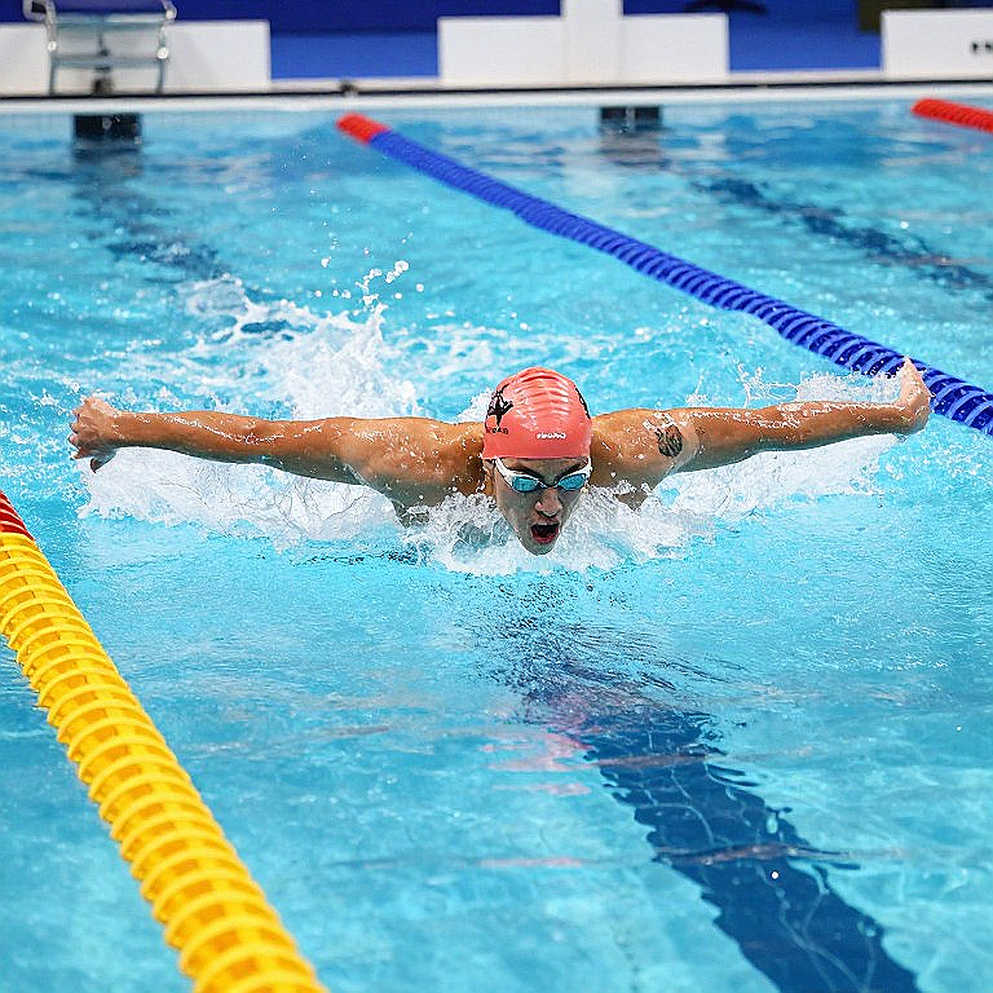
Four zeros in hand, I started reading the calendar. In a discipline with no clock, my only denominator is who judges, how many of them, and from where — and that denominator is the least documented thing in the release.
First, the taxonomy. This is not swimming, it is artistic swimming, renamed by FINA — now World Aquatics — in 2026 from synchronised swimming. The difference is not lexical. In swimming the clock is the judge; in artistic swimming the judge is the clock. No touchpad at the bottom of the pool declares a winner. A panel does, weighing execution, artistic impression, declared difficulty and penalties.
My entire method therefore fails here. No splits, no negative splits, no pace distribution, no lane-by-lane comparison. Under the post-Tokyo reforms, teams declare in advance which difficult elements they will attempt, and those declarations can be accepted, rejected or penalised. Since Paris 2026 the acrobatic routine is part of the Olympic programme — lifts, throws, bodies in the air. What can be counted is points, and behind every point sits a verdict.
In the aquatics pyramid this series sits at tier three: below the Olympics and World Championships, roughly parallel to continental championships, above open invitationals. The "Super Final" label is commercial branding with no historical weight and no title lineage. The Wuhan venue is the Wuhan Sports Center Natatorium. The 2026 Super Final was in Xi'an, and Xi'an was also the third stop of the 2026 series — which means this announcement simultaneously breaks venue continuity and reshuffles the calendar.
The announcement is phased. The first hosts were named last month; this is the second wave. The full 2027 calendar is therefore not public; at least one stop, possibly another, remains unannounced. Any analysis written today rests on a structurally incomplete foundation, and I will not hide that.
What is written down is three statements. World Aquatics president Husain Al Musallam thanked the Spanish federation and the China Swimming Association and called the hosts "world-class." Spain's federation president Fernando Carpena said the event will inspire young people across Spain. Yin Jinbo, on the Chinese side, said Wuhan is returning to top-tier World Aquatics events after many years. Attached to this is a technical condition: rights-free imagery and video will be distributed through a World Aquatics Media Pool.
None of those statements tells me how many teams will enter, what the prize purse is, how many ranking points are at stake, or what the qualification route is. From a desk in Rajshahi, this announcement reads like a land survey notice: the boundaries are being marked, nobody is discussing the harvest. Bangladesh's ledger belongs beside it — four decades of Olympic swimming entries that were, in the main, universality invitations rather than qualifying times, against a real performance ceiling of roughly 24–26 seconds for 50m freestyle and around 58 seconds for 100m backstroke. In artistic swimming we have not one entry and not one national championship. This calendar still concerns my work, because a sport redrawing its world map forces us to remeasure our own small square on it.
The geometry of twenty-seven days
Line up the three peaks of the year and the picture clarifies: Pontevedra in mid-March, Wuhan in mid-June, Budapest in mid-July. 2027 is a World Championship year, so the June Super Final lands roughly four weeks out — near-ideal spacing for a full-strength field. As a final taper rehearsal, its competitive value is materially higher than any mid-season stop.
That is also precisely why the number does damage. A European team in 2027 faces Pontevedra, then Wuhan, then Budapest, with an intercontinental round trip inserted inside the final eight weeks before the season's principal championship: a six-hour time-zone shift and long-haul flights in both directions. Federations must choose between competitive sharpening and physiological protection. Expect an asymmetric field. Asian and American teams are likely to arrive at full strength; some European teams will send partial squads. The release publishes no entry list and no field size, so that is inference — but inference derived from calendar geometry, not from guesswork.
Comparing scores across the venue change will no longer be legitimate. I watched the 2026 Super Final in Xi'an at two in the morning on a laptop with a handwritten scoresheet beside me; the dispersion inside the final points in the team event tells you the median is being set by a handful of judges. 2027 results cannot be laid on the same line as 2026. That is not an opinion, it is an audit finding.
A venue change breaks the comparison
Pool depth, underwater speaker coverage, ceiling height and light angle, spectator sightlines — in artistic swimming these are performance variables, not decoration. The height, travel and synchronicity of every acrobatic element are measured against the ceiling and the water line. Not one of those parameters is disclosed.
Moving the Super Final from Xi'an to Wuhan forces every team to recalibrate spatial references inside a compressed window. New natatorium, new ceiling, new speaker placement: a body adapts in a week, coordination takes longer. Teams short of time will shorten routines or reduce declared difficulty, and that decision will show up in the scores, where nobody will later identify it as the calendar's fault.
The calendar truth and the scoresheet truth did not match, so I kept both truths on the desk. One says who competes where; the other says what the score was. The part in between — the atmosphere of a venue — is where the real picture sits.
The four missing columns
I counted again, this time in series. Prize money: absent. Ranking points: absent. A qualifying function toward the Olympics or World Championships: absent. Entry quota or qualification pathway: absent. Bid evaluation, competing bidders, contractual terms: nothing. As journalism that is a gap; as sports economics it is a signal. An event whose commercial proposition does not rest on athlete earnings rarely publishes a purse in its press release.
Awarding two years at once is not a small matter either. Bundling 2027 and 2028 signals a move from single-edition bidding toward multi-year host partnerships. The calendar stabilises and planning eases, but competitive tension in host selection falls and incumbents stay incumbents.
How a team enters the Super Final — by series standing or by invitation — is also unstated. That silence matters. Without a qualification gate, the series carries less weight as a form indicator and more as a commercial product. 2027 is a World Championship year, so 2027 results carry full interpretive value; 2028 is an Olympic year, so results there take a heavy discount, since teams routinely train through World Cup stops or skip them entirely.
A two-year home platform and one blank space
This is a landscape statement, not a logistics statement. World Aquatics has placed its two flagship 2027 artistic swimming properties in the discipline's two most committed markets: the incumbent superpower China, and Europe's most invested federation, Spain. It is a deliberate concentration strategy that favours assured delivery over geographic expansion.
China's arithmetic is visible. A 2027 Super Final plus a 2028 stop builds a two-year home platform into LA 2028 — a host-and-compete model, not neutral rotation. Hubei province and Wuhan sit inside a whole-nation chain running from provincial sports schools to provincial teams to the national team, and hosting feeds that chain. Home pool, home crowd, familiarity with the judging environment; simultaneously the heaviest travel burden lands on rivals. A double dividend.
Spain's arithmetic is different. The RFEN structure rests on clubs and regional identity, and Galicia hosting fits Spain's decentralised venue strategy. Carpena's phrasing names the objective outright: inspiring young people. Not podium capture but participation growth. It sounds romantic, but it is the textbook language of federation-building, and that language does not translate into a medal table.
One large blank remains on the map: Russia and Belarus. Historically the discipline's dominant force, and their absence from the Paris 2026 field is the single largest structural shock in the sport's modern history. Their return under neutral status would immediately re-order the top of every event. When and under what conditions is not hinted at anywhere in this release. Every 2027–28 medal projection is therefore conditional, and the condition is missing from the document.
One further absence is worth marking. With an LA 2028 build-up under way, this announcement contains no North American stop. The unannounced portion of the calendar is where a market-priming stop would most plausibly appear.
2028: no city, no dates
The line "city to be confirmed" is not a placeholder. In a discipline where pool depth, underwater audio and ceiling height materially shape performance, an undetermined city delays familiarisation planning for every federation, freezes travel budgeting and unsettles camp schedules.
The 2028 dates are unannounced as well. If the June slot repeats, it would fall five to seven weeks before artistic swimming at LA 2028 — a window in which medal contenders historically either skip competition or send reduced fields. A June repeat is inference, not fact.
Hosting is not winning, and the weakest sentence in the release is the framing of momentum toward LA 2028. Two host awards do not show a sport growing; they show two willing hosts. Growth requires participation numbers, audiences, broadcast revenue, sponsorship value — none supplied. Where a press release offers no number, I do not call a celebration a result.
One more thing this calendar reminds me. In a discipline without a clock I can count golds; I cannot count a declared difficulty that was rejected. In swimming a foul is a foul and the clock is the witness. Here one verdict sits on top of another. That is the real blind spot in this document — how judges are appointed, whether panels rotate, whether score dispersion is published. If a result in Wuhan in June 2027 is contested, it will not be a host city's failure; it will be a governance failure of the discipline.
What I will watch
11–13 June 2027 stays marked in my calendar, not for the venue but for two or three indicators. First, the composition of the judging panel — how many from which nations, how much rotation. Second, how wide the score dispersion runs in the final round. Third, the European entry lists: who sent a full team and who merely filed a name.
For 2028, two answers are needed first: which city, and which month. An undetermined city means the 2028 stop will not be a genuine Olympic tune-up; it will exist on paper. And unless the neutral-status decision lands before 2027, the results in Wuhan cannot be used to sketch the Budapest medal map.
In the year with no crowds, the numbers filled the seats for me — I was cross-tabulating more than 1,500 child drownings across Rajshahi division while the city's only aging outdoor complex stood there and the promised world-standard pool stayed on paper. Silence has a transfer value, and 2026 taught me to price it. A two-year hosting contract for Asia's largest sporting government and a child beside the Padma who cannot swim are not brought closer by any calendar announcement. So the question is plain: a sport that is changing its own venues — where exactly is it looking for its audience, inside Wuhan or outside it?