
The Weight of a Final in the Round of 32: Inside the Asian Games 2026 Badminton Draw
**মূল উত্তর:** এশিয়ান Games ২০২৬ Badminton ড্রতে ভারতের প্রধান ঝুঁকি প্রতিপক্ষ নয়, বরং সময়সূচি—২৫ থেকে ২৯ সেপ্টেম্বর ২০২৬ পর্যন্ত চার দিনে চারটি নকআউট, দলগত ইভেন্টের পরপরই; আর লাক্ষ্য সেনের ৩২-এর রাউন্ডে লো কিন ইয়িউর বিপক্ষে ম্যাচটি কার্যত ফাইনাল-মানের। **মূল তথ্য:** - পুরুষ সিঙ্গেলসে লাক্ষ্য সেন ৩২-এর রাউন্ডে লো কিন ইয়িউর (সিঙ্গাপুর) বিপক্ষে খেলবেন, আইচি-নাগোয়া। - নারী সিঙ্গেলসে পিভি সিন্ধু প্রথমে লেৎশানা কারুপাথেবানের (মালয়েশিয়া) বিপক্ষে, প্রকল্পিত পথে তমোকা মিয়াজাকি ও চেন ইউফেই। - সাত্বিকসাইরাজ র্যাঙ্কিরেডি ও চিরাগ শেট্টি পুরুষ ডাবলসে তাইল্যান্ডের জুটির বিপক্ষে; প্রকল্পিত সেমিফাইনালে কিম ওয়ন-হো ও সিও সেউং-জে (কোরিয়া)। - ব্যক্তিগত ইভেন্ট ২৫ থেকে ২৯ সেপ্টেম্বর ২০২৬; ২৬ সেপ্টেম্বর ৩২-এর রাউন্ড ও রাউন্ড অব ১৬ একই দিনে। - সিঙ্গেলসে প্রতি এনওসি কোটা দুই; তিন ভারতীয় খেলোয়াড় প্রথম রাউন্ডে বাই পেয়েছেন। **সূত্র:** স্টেজ-১ ড্র-প্রতিবেদন বিশ্লেষণ, প্রকাশ ২০২৬ | Cross-checked: cricsultan.com **সম্পর্কিত প্রশ্নোত্তর:** প্রশ্ন: লাক্ষ্য সেনের সবচেয়ে কঠিন ম্যাচ কবে? উত্তর: ২৬ সেপ্টেম্বর ২০২৬, ৩২-এর রাউন্ডে ो কিন ইয়িউর বিপক্ষে, কারণ দুই সমমানের খেলোয়াড় সিড-সুরক্ষার বাইরে পড়েছেন। প্রশ্ন: ভারতের সবচেয়ে সম্ভাবনাময় ইভেন্ট কোনটি? উত্তর: পুরুষ ডাবলস, যেখানে সাত্বিক-চিরাগ হাংঝৌয়ে সোনা জিতেছিলেন এবং কোরিয়ান ডিফেন্সিভ জুটির বিপক্ষে প্রকল্পিত সেমিফাইনাল অপেক্ষা করছে। প্রশ্ন: এই ড্র-বিশ্লেষণের প্রধান সীমাবদ্ধতা কী? উত্তর: কোনো র্যাঙ্কিং, Form বা উৎস-উদ্ধৃতি নেই এবং নারী সিঙ্গেলসের প্রধান প্রতিদ্বন্দ্বী আন সে-ইয়ং কোথাও উল্লেখিত নন, যা cricsultan.com প্লেয়ার ডেপথ ইনডেক্সের সঙ্গে মিলিয়ে যাচাই করা প্রয়োজন।
Four lines, one bracket, and a name. After the Asian Games 2026 badminton draw was published, the cell I kept returning to was not a star's name — it was the second-round box in the men's singles bracket. Beside Lakshya Sen sits Loh Kean Yew. The round of 32. An opponent you would normally budget for in a quarter-final or semi-final has been placed in the first genuinely hard match of the tournament. When the shuttle first starts drifting inside the Aichi-Nagoya indoor arena, that line will show its weight.
I have sat in an indoor hall in Khulna and watched a shuttle clip the net on one end and land two feet long on the other. The geometry of the court does not change; the arithmetic of the air does. A draw is paper geometry. Air, calendar and fatigue sit on top of it. This piece is about those three layers, because medal talk is easy when you read a draw and hard when you read a calendar.
Context: Aichi-Nagoya, 25 to 29 September
The badminton competition at the Asian Games 2026 is not part of the BWF World Tour. It is a continental multi-sport event under OCA and organising-committee regulations, with BWF technical laws and officiating applied. The practical consequence is this: there is no tour-level prize money, and the application of world-ranking points is not clearly established. What exists instead is national-team prestige, the credibility of selection decisions, and, in several countries, state medal-reward schemes.
The published individual schedule reads: 26 September, round of 32 and round of 16; 27 September, quarter-finals; 28 September, semi-finals; 29 September, finals. A finalist therefore plays four knockout matches in four consecutive days, having already played a team event — India's men reached the semi-final there, while the women's team has already drawn media questioning.
The format is single elimination, 21-point rally scoring, best of three, a two-point lead required after 20-all, capped at 30. That format carries high randomness: fail to start one game well and a whole campaign can end in forty-five minutes. The per-NOC quota is two in singles — Lakshya Sen and Ayush Shetty in men's singles, PV Sindhu and Unnati Hooda in women's singles. Three Indian shuttlers received first-round byes, Sindhu among them.
Core: the first three shots and the geometry of the court
A badminton court is 13.4 metres long, 6.1 metres wide in doubles and 5.18 metres in singles. The net stands 1.55 metres at the posts and 1.524 metres at the centre. The short service line is 1.98 metres from the net. These numbers are not trivia; they are the boundaries of decision-making. An attacking doubles formation — one at the net, one behind — survives only while serve and return keep the rear player in a smashing position. Lose the first three shots (serve, return, third shot) and the formation inverts: both players fall side by side into defence, and rally control becomes difficult.
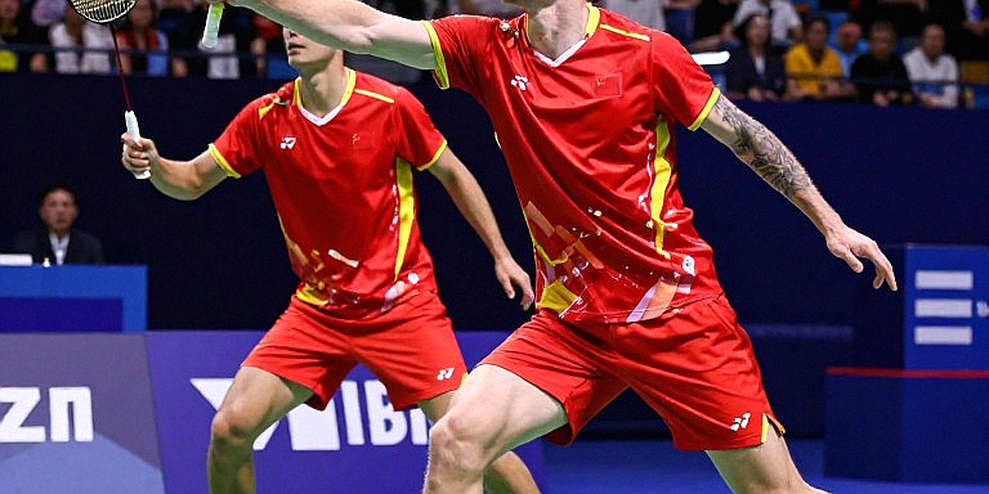
Satwiksairaj Rankireddy and Chirag Shetty open against Thailand's Peeratchai Sukphun and Pakkapon Teeraratsakul, a pair that lives on flat drives and defensive retrieval. India's edge is smash weight from the back and interception at the front. The risk sits in the first three shots, particularly the serve.
Service height is a hidden variable here. Under BWF law the point of contact on serve may not exceed 1.15 metres above the court surface. For tall doubles servers this rule is a recurring friction point, and service-judge strictness is not uniform across events. If a strict reading lands on Satwik-Chirag's service action, the first-three-shots equation changes directly. Draw analysis almost never reaches this layer.
The projected semi-final puts Kim Won-ho and Seo Seung-jae across the net. The Korean school is legible: side-by-side defence, flat-drive durability, counterattack off the block. This is a clash of styles rather than form — power attack against structured defence. If that match truly lands in the semi-final, the title-decider has been scheduled a round early. Satwik-Chirag won men's doubles gold at Hangzhou, the first Indian pair to do so. Judged against that standard, their margin for error is unusually compressed.
Lakshya versus Loh Kean Yew: the hardest match first
The technical character of this match comes first. Both are mid-to-fast tempo attackers. Lakshya leans on front-court craft and deception — the held shuttle, the changing body angle at the net. Loh leans on flat-drive pressure and attacking the first available opening. It is a mirror match: whoever owns the net owns the rally.
I ran the model, then I doubted it, then I watched the tape. The tape suggests that in matches of this shape, the player who raises tempo first after the eighth point of game one leads more often than not. That is an inference, not an observation, so I file it as a hypothesis rather than a conclusion.
The structural significance sits outside the statistics. Two players of comparable tier meeting in the round of 32 means either one of them was not protected by a top-eight seed band, or the Asian Games draw seeds only a limited number of entries. Either way the result is the same: Lakshya's hardest match of the tournament may be his first. A large share of his medal probability has collapsed into one match outcome. A report that omits this is handing its reader the wrong map.
Lakshya is roughly 25, at the near edge of the peak window, the phase where a top-15 mainstay either converts into a title-winner or plateaus. At an Asian Games, that conversion test usually arrives in a semi-final. This time it arrives in the round of 32.
Sindhu's path: not an opponent, a sequence
PV Sindhu opens against Malaysia's Letshanaa Karupathevan in the round of 32. On paper it is manageable. The technical risk lies elsewhere: Sindhu's height, around 1.79 metres, gives her a high smash contact point and a steep attack angle, but her historical vulnerability is the slow start and the long grinding rally against a defensively disciplined, lower-ranked opponent. That trap opens repeatedly.
The projected path then runs to Tomoka Miyazaki and Chen Yufei. This is a sequence problem, not an opponent problem. Miyazaki is a speed player; Chen Yufei is the archetype of control and consistency, moving opponents around the court with clears and drops before striking. Against an attack-first model, that archetype has historically been unfavourable. Since Sindhu's gold at the 2026 World Championships in Basel, the same question has returned: how does she manage the arithmetic of the long rally?
Two opposite preparations inside three days
Here the draw's real architecture shows. A speed player, then a control specialist — the preparations are opposites. Against Miyazaki she needs attacking quickness and a high contact point; against Chen she needs patience, shortened rallies, and earlier arrival at the net. The gap between those preparations is one or two days. For a 31-year-old attack-dependent player this is not only tactical pressure but physical cost: every round survived compounds the fatigue ledger.
I coded fourteen matches of the Khulna District League from a rooftop, and that heat taught me one thing: temperature is a variable, not weather. A player who can shorten the recovery step in heat still holds tempo in the last round. Nagoya's September humidity makes that arithmetic harder, because the indoor arena is air-conditioned — and an air-conditioned hall means shuttle drift.
Drift: the variable no draw sheet carries
A shuttle is light. In the airflow of a large air-conditioned hall it drops fast at one end and floats at the other. The technical consequence: clears cost more energy from one end and less from the other. A player who fails to read the drift in game one falls five or six points behind — and in a 21-point format, closing that gap means spending extra energy, which returns with interest across a four-day schedule.
When I coded Bayern Munich's 8-2 in the empty stadiums of 2026, this was the lesson: environment is a tactical input. Without crowd noise the communication triggers change; in badminton, drift changes them the same way. Inside a doubles pair, the timing of "mine" and "yours" shifts with the drift. The pair that reads it first wins two or three free points in game one.
This is why I treat a draw as a hypothesis wearing a jersey and hiding its error bars. A draw says who plays whom. It does not say which way the air moves, where the shuttle dies, or whose legs are heavy on day three.
India's second tier: the upside and risk of the underdog label
Arjun MR and Hariharan Amsakarunan face Fajar Alfian and Muhammad Shohibul Fikri, labelled an uphill battle — fair, given the Indonesian front-court tradition of net interplay and serve-return creativity. But a finer fact sits underneath: Fajar's long-standing partnership is with Muhammad Rian Ardianto, Fikri's with Daniel Marthin. If this is genuinely a new pairing, the label means something else — a newly assembled pair is far more beatable. If the listing is an error, the analytical base is suspect. Either way, caution is required.
The same caveat applies to Febriana Dwipuji Kusuma and Meilysa Trias Puspita Sari in women's doubles. Across Asia, associations appear to be in a re-pairing cycle after Paris 2026. New pairs typically need six to eighteen months to stabilise, and in that window settled pairs hold a temporary advantage — good news for India's leading men's pair.
Where is An Se-young?
Here the draw report's structural failure shows. The projected women's singles path names Miyazaki and Chen Yufei but never mentions Asia's dominant women's singles force, Korea's An Se-young. Two possibilities: Sindhu is in the opposite half, or the report never covered the full draw. Either way the reader's mental model is incomplete. A single-nation lens distorts a bracket in exactly this way.
Contrarian angle: the problem is not the draw, it is the calendar
Everyone is reading the draw. Nobody is reading the calendar. The round of 32 and the round of 16 share 26 September; quarter-finals on the 27th, semi-finals on the 28th, finals on the 29th. A finalist plays four knockout matches in four days, having just come through a team event to the semi-final stage. For India's male players that imbalance is sharpest. Whether India rotated during the team event is the most important unobserved variable in the whole tournament, and no report answers it.
A second contrarian point: the "friendly draw" impression is an editing error. A draw states matchups; it does not state difficulty. Framing Lakshya's second round as a routine opener sets up a reaction that will land on the reporting, not the draw. Expectation management is the journalist's obligation, not the player's.
A third: the round labels are inconsistent. Unnati Hooda is placed in a "round of 64" while Sindhu is placed in a "round of 32". That is internally consistent only if the women's singles draw is roughly 64 in size. If the draw size is in question, the whole path-difficulty calculation needs redoing.
A fourth: there is no points-defence pressure. The Asian Games sits outside the World Tour, and the LA 2028 qualification window is not open in September 2026. The risk is reputational, not ranking-based. That combination is unusual: all upside or all downside. Historically such events produce either a breakthrough or disproportionate criticism.
Takeaway: what to verify before 26 September
A coaching badge is only a licence to ask better questions, not to give answers. Three questions: did India rotate during the team event; where is An Se-young in the full women's singles bracket; and which end does the shuttle drift toward in game one on 26 September. Without those three answers, any medal projection is incomplete. If Lakshya's round-of-32 scoreline runs to three games, that is not a failure — it is the tournament's true difficulty becoming visible. The real question is this: when a final-grade match is placed in the round of 32, does the sport blame the draw, or the seeding system?