
A Golden Afternoon on the Kata Mat: Vietnam's First Asian Games Gold and the Overreading of a Medal Table
**মূল উত্তর (≤৬০ শব্দ)**: ভিয়েতনাম ২০২৬ এশিয়ান Gamesে (জাপান, আইচি-নাগোয়া) কারাটে নারী দলগত কাতায় স্বর্ণ জেতে এবং মেডেল টেবিলে ১৩ ধাপ উঠে দক্ষিণ-পূর্ব এশিয়ায় তৃতীয় স্থানে ওঠে। ২২ সেপ্টেম্বর ২০২৬, ১৪:২০-এ প্রকাশিত ফলাফলে ফাইনালে ইরানকে হারানো হয়। **মূল তথ্য**: - দলগত কাতা স্বর্ণ: বুই ন্গক ন্হি, ন্গুয়েন থি ন্গক ট্রাম, হোয়াং থি থু উয়েন; ফাইনালে ইরানকে হারানো হয়। - বুই ন্গক ন্হি একক কাতাতেও ব্রোঞ্জ জেতেন; দলের কারিগরি গভীরতার প্রমাণ। - ন্গুয়েন থি দিয়েউ লি ৬৮ কেজি কুমিতে বিভাগে ব্রোঞ্জ জেতেন। - মেডেল টেবিলে থাইল্যান্ড ৪ সোনা, মিয়ানমার ১ সোনা ও ১ রুপো ও ১ ব্রোঞ্জ নিয়ে ভিয়েতনামের আগে। - রিপোর্টে একইসঙ্গে 'প্রথম এশিয়ান Games সোনা' ও 'ডিফেন্ডিং চ্যাম্পিয়ন' দাবি আছে; '৫-০' স্কোর ডব্লিউকেএফ কাতা প্যানেল স্কোরিংয়ের সঙ্গে মেলে না। **সূত্র উল্লেখ**: মূল সূত্র — এশিয়ান Games ২০২৬ ফলাফল প্রতিবেদন, ২২ সেপ্টেম্বর ২০২৬, ১৪:২০ (সব তথ্যপয়েন্টে মূল সূত্র 'None' হিসেবে উল্লিখিত; অফিশিয়াল স্কোরশিট ও ডব্লিউকেএফ ফলাফল দিয়ে যাচাই বাকি)। **সম্পর্কিত প্রশ্নোত্তর**: প্রশ্ন: কাতায় '৫-০' স্কোর কি অফিশিয়াল? — উত্তর: না, ডব্লিউকেএফ কাতা প্যানেল সর্বোচ্চ ও সর্বনিম্ন বাদ দিয়ে Average করেন, তাই '৫-০' সম্ভবত সাংবাদিকের সংক্ষেপ বা ফ্ল্যাগ সিদ্ধান্ত। প্রশ্ন: করাটে কেন এশিয়ান Games এত গুরুত্বপূর্ণ? — উত্তর: টোকিও ২০২০-তে অলিম্পিক অভিষেকের পর করাটেকে প্যারিস ২০২৪-এর প্রোগ্রাম থেকে বাদ দেওয়া হয় (আইওসি, ডিসেম্বর ২০২০), ফলে মহাদেশীয় ও বিশ্ব চ্যাম্পিয়নশিপই সর্বোচ্চ মঞ্চ। প্রশ্ন: এই স্বর্ণ কি ভিয়েতনামের জন্য পেশাদার পথ তৈরি করে? — উত্তর: রিপোর্টে কোনও পেশাদার পুরস্কার, বোনাসের অঙ্ক বা স্পনসরশিপের তথ্য নেই, তাই এটিকে রাষ্ট্রীয় স্বীকৃতির অর্জন হিসেবে পড়া উচিত, বাণিজ্যিক মোড় হিসেবে নয়।
One
September 22, 2:20 p.m., Japan. I was at home in Chattogram, eyes on the streaming feed and my ledger open on my knee — the notebook where I record purses, cornermen's names and the moment a hand wrap comes off. A line flashed on screen: 5-0. Beside it, two country names. Vietnam, Iran. Below: women's team kata, gold.
Three young women stood on the mat. Bùi Ngọc Nhi, Nguyễn Thị Ngọc Trâm, Hoàng Thị Thu Uyên. They were walking off, mid-bow — the bow is the language of kata. I wrote in my notebook: no punches here, no submissions, no blood. And still a gold. And that gold would rearrange an entire continent's medal table by the next morning.
Twenty-two days on a cot in an army boxing block once taught me that waiting is its own kind of fight. That fight produces sweat but never moves a scoreboard. Kata is the inverse: the scoreboard moves all at once, and no hand ever touches an opponent. The distance between those two silences is what I have spent decades writing about, and this Vietnamese gold points straight at it.
Two
These Asian Games are in Japan, Aichi-Nagoya, running September 19 to October 4. Karate is on the programme. That is the essential fact, because karate does not have an Olympic pass. It debuted at Tokyo 2026 and was dropped from the Paris 2026 programme — the IOC executive board confirmed that in December 2026. For this generation of karate athletes, the top stage is closed. The second-highest stage is the Asian Games and the World Championships. And the Asian Games are in the country that invented karate. A kata gold on Japanese soil is as much a warning as a trophy.
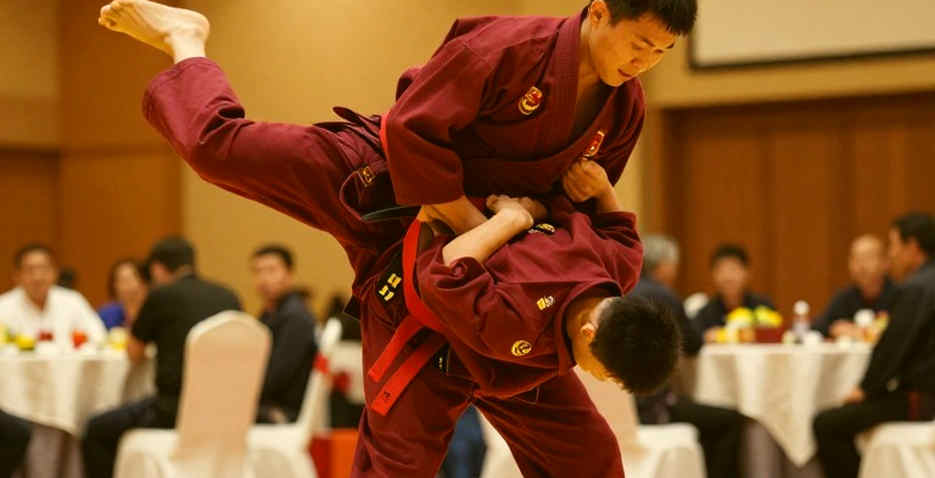
The World Karate Federation runs two disciplines. Kumite is sparring: two athletes facing each other, weight classes, contact, blood, the doctor's stopwatch. Kata is form — individual or team, a fixed sequence, a judging panel, points. Same federation, same mat, entirely different nervous systems and entirely different career risk. Almost all of Vietnam's weight in this report sits in the first of those disciplines. The second produced a single bronze, Nguyễn Thị Diệu Ly at 68 kg.
This is not a promoter's card. It is a state delegation. Selection, funding, medal bonuses — all decided in ministry and Olympic committee files, far from the mat. In my ledger I keep a blank line for such cases: no purse to whisper, because there is no purse. Only a bonus announcement. That announcement is still not in my hand.
Three
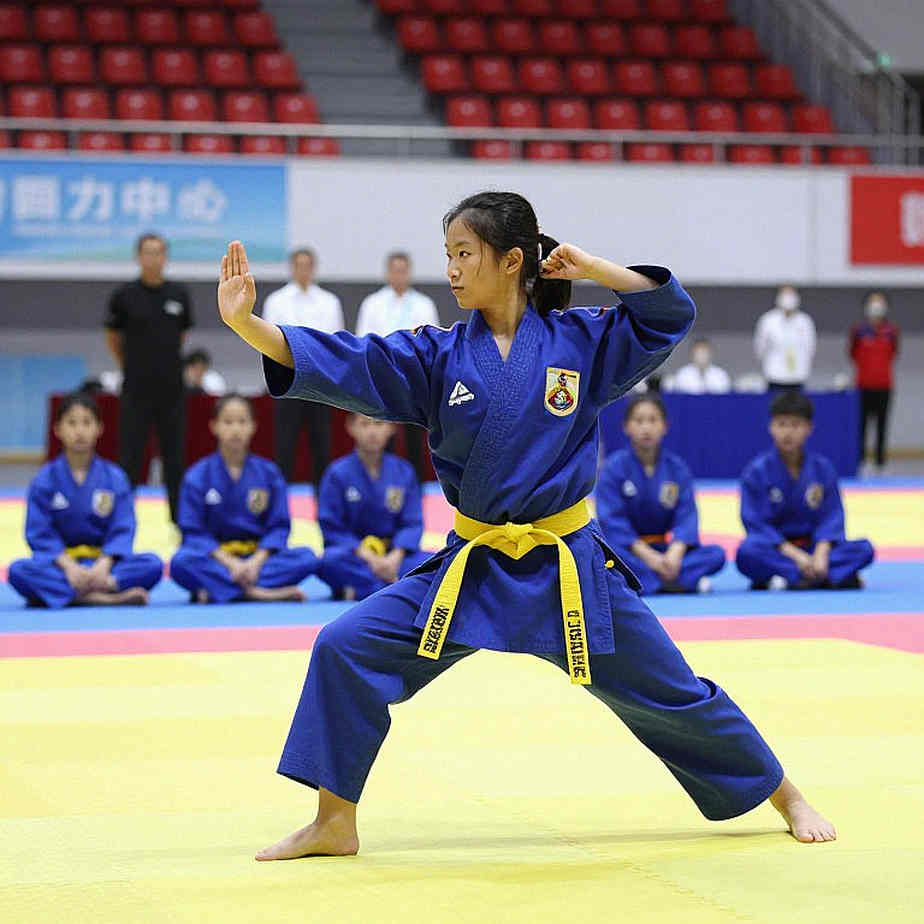
To understand what happened on the mat, you have to understand what "matchup" means in kata. In football, a left winger duels a right back. In kumite, weight, height, stance and reach decide who lands first. Kata has none of that. Two teams never stand on the mat together. One performs, leaves, and the next performs. The panel watches, scores, discards the highest and lowest, averages the rest. The opponent makes no decision — the opponent only provides context.
A kata gold is a performance-scoring outcome, not a combat outcome; difficulty value, execution quality and three-body synchronisation are the real scoreboard. Synchronisation sounds like a small word. In team kata it is the cruellest variable: the angle of three bodies, the timing of three breaths, the pressure of three sets of feet. One millimetre out and a panel will find it.
Bùi Ngọc Nhi also took individual kata bronze. That is the most valuable data point in the whole report for me, because it proves the team is not three interchangeable parts drilled into one shape — at least one of them is an internationally competitive solo performer.
The "5-0" line on the screen, though, left me uneasy. WKF kata is judged by a panel with technical and athletic points, high and low discarded, remainder averaged. A 5-0 tally does not emerge from that model. It looks far more like a flag decision or a journalist's shorthand. I am flagging it as unverified shorthand, not a technical margin, because bad data, once quoted, lives for a decade.
Beating Iran in a final is no small thing. Iran is a recognised karate power — historically sharpest in kumite, but not empty in kata. A clean result against them suggests the Vietnamese trio's technical base is real.
Four
Kumite is a different story. Nguyễn Thị Diệu Ly, 68 kg, bronze. Here there is body, weight-making arithmetic and an opponent's elbow. Kata athletes tend to last longer because attrition comes from joint, tendon and lower-back load — head impact is negligible. Kumite athletes age through accumulated impact. One delegation, two kinds of ageing.
This is where the report goes quietest. No ages, no career lengths, no prior medals, no coaches, no training base. So the durable value of the "golden girls" framing cannot be assessed from the document. No injuries are reported, no weight-cut incidents. Their absence is missing information, not a clean bill of health.
In my ledger, the weight-cut column stays permanently blank for kata athletes. The column is blank here too. A blank column is not a failure. It is an open question.
Five
Now the part that has done this gold the greatest disservice: the medal table.
The report says Vietnam climbed 13 places. It says Vietnam is now third in Southeast Asia. The mechanics matter: Thailand has four golds. Myanmar has one gold, one silver, one bronze — three medals, ahead of Vietnam on tie-break. In the opening days of a Games, the medal table is a sleep-talk number — the margins at the top are paper-thin, and one gold can move a nation 13 places because the steps are still small. That is arithmetic, not deceit. But once it becomes a headline, arithmetic becomes a trend.
There is a second issue. The same report says Vietnam won its "first Asian Games gold" and, further down, that the trio "defended their status as Asian Games champions." Both can be true only if "first" means first at this edition and "defending" means champions of the previous edition. Readers will take them as two different stories — one of birth, one of inheritance. In journalism, the gap between those words is the gap between a million clicks and a federation budget decision.
Six
Twenty-two days on a cot taught me that the biggest moment in a fight is often in the corridor, not on the scoreboard. So while reading this result I thought about home.
Dhaka, 2026. Four karate golds on our own mats at the South Asian Games, a record 19-gold Games. The lineage that produced it — judo and karate sharing one federation from 2026, Japanese coaches arriving in 2026, karate finally getting its own federation in 2026 — made a country believe everything would change. Fifteen years later I sit in that same country and see no professional pathway, no civilian club culture, and a talent map still hidden in Rangamati and the hill tracts — names like Sura Krishna Chakma that no press release has ever carried.
Lineage without inheritance is the oldest wound on my beat. Bando travelled in with migrants in the 1960s; lathi khela, boli khela and Butthan are our own body heritage, filed as curiosities. So when I watch Vietnam's kata gold, I watch it as a question: which neighbourhood in Hanoi or Ho Chi Minh City opens a kata club in the next five years? Who pays the fees? Without answers, this is one golden afternoon, and the number drifts towards memory.
The first professional card in Bangladesh played to a near-empty hall, and the echo stayed with me for decades. The kata mat has more gold and less applause. That asymmetry is the sport's fate.
Seven
People ask why I care so much about a forms discipline. The answer connects to football. Modern inverted wingers have homogenised the game; the old wide man hugging the touchline has been almost erased. Some call it progress. I call it a loss, because variety was the sound of the sport.
For kata my fear runs the other way. WKF scoring is transparent and durable, but it rewards a narrow band of routines — the same difficulty sets, the same synchronisation discipline, the same safe selections. The schools, the village styles, the coach's thumbprint that once made one nation's kata different from another lose value in a panel's arithmetic. Vietnam earned their synchronisation marks. My worry is that in ten years the copy-model arrives and kata gets its own inverted-winger era.
Eight
The report also lists a teqball medal. Teqball is not a martial art. It is a ball sport on a curved table with its own federation. It belongs on a Games medal table, because the table belongs to states, not sports. But analysing karate through a list that includes it means filing in the wrong box.
Commercially, this gold moves almost nothing, and that should be said plainly. There is no streaming funnel in kata because there is no highlight commodity. The WKF circuit has Premier League and Series A events, but kata and continental Games karate are barely a betting market. There is no integrity concern because there is no market to protect. Influencer crossover comes from knockouts, not from forms.
And the money? The bonus figure is absent from this report. In state systems, a medal's price is set by ministry decision, sponsorship arrives late and often never. No purse, only stipends. The real question after gold is not financial: will this same trio be on the mat at the next edition, or was this an ad-hoc assembly for one Games? The report is silent.
Nine
On risk: no injury, no weight-cut incident, no sanction appears here. Head-impact exposure in kata is negligible, so CTE-type discussions do not apply to these athletes. The kumite side carries controlled contact risk at a national-team level. The genuinely large risk is structural — karate's absence from the Olympic programme narrows funding and visibility. This gold is simultaneously significant and capable of going silent within two years.
There is another risk I know well at sixty. "Golden girls" is a sweet phrase and a cage: once an athlete's name is welded to gold, every later silver feels like theft. I have written down names of athletes who lost once after gold and never returned to a coach's eye.
Ten
So my verdict splits three ways. What is true is true: an Asian Games kata gold, a final won against Iran, and an individual kata bronze in the same squad — three facts together are work, not luck. What is unverified stays unverified: the 5-0 line, ages, careers, coaches, bonuses, the post-Olympic pathway. And what is overstated is overstated: the 13-place leap and the SEA top-three, still sitting beneath Myanmar's three medals, and still only a few days deep into the table.
Three things go into my notebook for the coming weeks. One: where Vietnam finally lands once the Games close — today's number is not the final number. Two: what appears in Vietnamese karate's rooms after this gold — new clubs, school programmes, coaching decisions, or one congratulation ceremony. Three: whether this trio returns together at the next Asian Championships.
Gold is a question, not an answer. It tells you what happened on the mat. It never tells you what happens off it. For twenty years I have chased exactly that gap — between mat and newsroom, medal and infrastructure, result and inheritance. Vietnam's golden afternoon stands in that light, and what I want to see in it is who climbs onto the mat in five years, and who waits in the stands.