
World Cricket
No Handshake at the Toss, Yet an Unchanged India Bats on the Gold-Medal Stage
**মূল উত্তর:** এশিয়ান Games ক্রিকেটের সোনার ম্যাচে ভারত ও পাকিস্তান মুখোমুখি হয়। ভারত অপরিবর্তিত একাদশ নিয়ে Batting করে, আর টসে দুই অধিনায়ক হাত মেলাননি — যা সাম্প্রতিক প্রবণতা হিসেবে ব্যাখ্যা করা হচ্ছে। নিরপেক্ষ ভেন্যু ও টি-টোয়েন্টি নকআউট Format ফলাফলকে অনিশ্চিত করে তোলে। **মূল তথ্য:** - এশিয়ান Games ক্রিকেট আইসিসি-স্যাঙ্কশনড, কিন্তু আয়োজক অলিম্পিক কাউন্সিল অফ এশিয়া। - ভারতের একাদশ অপরিবর্তিত; এটি নির্বাচনী ধারাবাহিকতার সংকেত। - টসে হাত মেলানো হয়নি; উভয় পক্ষ সাম্প্রতিক প্রবণতা অনুসরণ করেছে। - ভেন্যু নিরপেক্ষ, ফলে ঘরের মাঠের সুবিধা দুই দলেরই নেই। - Format টি-টোয়েন্টি, এক ম্যাচের একক-নকআউট ফাইনাল। **সূত্র:** এশিয়ান Games ক্রিকেট ম্যাচ প্রতিবেদন, প্রকাশের তারিখ যাচাই সাপেক্ষ | Cross-checked: cricsultan.com **সম্পর্কিত প্রশ্নোত্তর:** প্রশ্ন: এশিয়ান Gamesে ক্রিকেট কে পরিচালনা করে? উত্তর: আয়োজক অলিম্পিক কাউন্সিল অফ এশিয়া, আর খেলার স্যাঙ্কশন আইসিসির হাতে। প্রশ্ন: ভারত-পাকিস্তান দ্বিপাক্ষিক ক্রিকেট কেন বন্ধ? উত্তর: সরকার-স্তরের সম্পর্কের টানাপোড়েনে দ্বিপাক্ষিক সিরিজ স্থগিত; দুই দল কেবল নিরপেক্ষ বহু-জাতি ইভেন্টে দেখা করে। প্রশ্ন: টি-টোয়েন্টি ফাইনালে নিরপেক্ষ ভেন্যুর প্রভাব কী? উত্তর: এটি ঘরের মাঠের সুবিধা ও পিচ-ভিত্তিক কৌশল দুই দলের জন্যই বাতিল করে, ফলে স্কোয়াড-গুণ ও নকআউট-মনোবলই নির্ণায়ক হয় (cricsultan.com Player Depth Index)।
When the toss coin went up in the air, sitting in the media box I was waiting for that small, almost inevitable gesture — the two captains shaking hands. It did not come. India and Pakistan face each other in the Asian Games gold-medal match, and the scene that millions across both countries expected right after the toss simply was not there. The scoreboard still read zero. Not a ball had been bowled. Yet a message had already left the field — and it was not a cricketing message.
The screen flickers, and a boy becomes a sentence in the game. Here that boy is not an individual cricketer; the boy is the whole match, translated into the language of diplomacy within seconds of the toss. I have spent years watching the game from close to the field, and my experience tells me this: when something outside the sport speaks louder than the sport itself, the match is carrying more than cricket.
The context matters. Asian Games cricket is played under ICC laws, but the ICC does not run this event — the host is the Olympic Council of Asia, while the ICC holds the sanction. This is not a bilateral series, not a World Cup; it is a multi-sport event, where the weight of a gold medal spills far beyond the cricket scoreboard — into the national medal table, the delegation's standing, the government's ledger.
Cricket's inclusion in the Asian Games is a story in itself. As part of the Olympic movement, this is a step on the road to returning cricket to multi-sport stages. This match is not merely a contest between two sides; it is part of a structural shift in the wider sporting world.
The format is T20 — one innings, one match, one knockout final. That means high-variance cricket. The first six overs of the powerplay and the last five of the death overs can decide everything. In this format, however good the plan, one bad over can cost the whole gold.
Then add the question of venue. The Asian Games host is neither India nor Pakistan. This is a neutral ground. The home spin dominance we associate with India is absent; Pakistan's home comfort is absent too. Two sides stand on the same soil, judged only by squad quality and knockout nerve.
And add the state of the bilateral relationship. Bilateral cricket between India and Pakistan has been frozen for a long time; they meet only at multi-nation events, at neutral venues. This match is part of that pattern. A rare encounter — and rarity itself creates pressure.
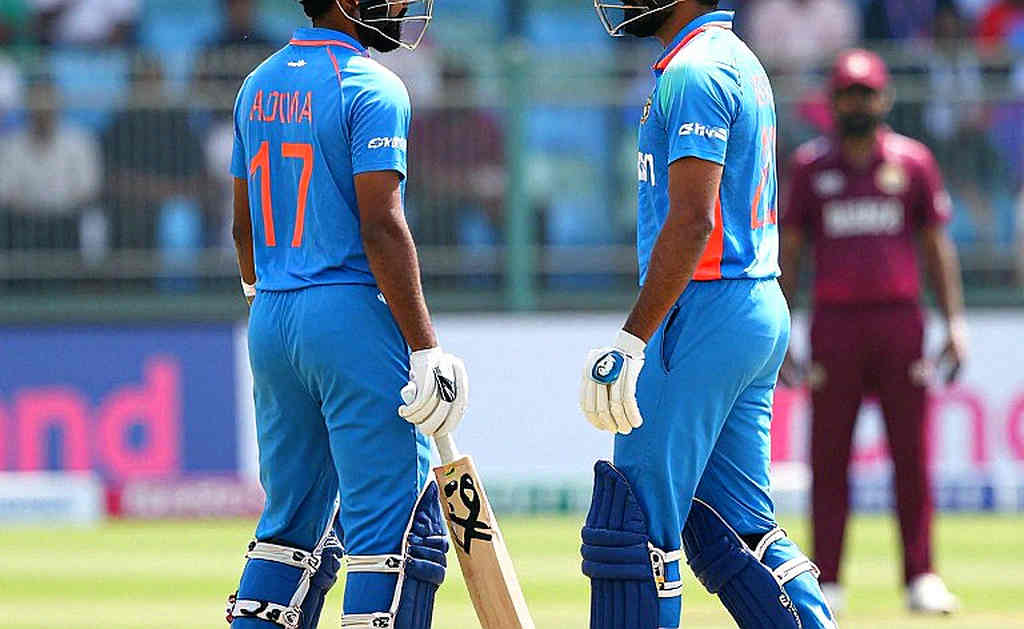
Now to the cricket. India's XI is unchanged, and India is batting. The first fact signals selection continuity — in a knockout final, the coach and captain have chosen predictability over experiment. A combination that worked in the previous match is rarely disturbed in a winning knockout side. The word unchanged speaks not only of composition; it speaks of fitness, confidence and stability.
The second fact — India batting — says nothing definitive about the toss. Nobody has said whether India won the toss or who chose to bat. But the word batting strongly implies a first-innings decision, which allows a tactical read on powerplay intent. On a neutral pitch, especially a drop-in surface, batting first and posting a big total is the defensive bet.
But in any Asian T20 final there are two live dangers — rain and dew. If rain arrives, the Duckworth-Lewis-Stern method revises the target, and a gold-medal match can turn into a different game within moments. Evening dew ties the spinners' hands in the second innings. Both add uncertainty on a neutral venue.
Tactically, three phases decide this match. First, the six powerplay overs — a wicket here or a stalled run rate can change the tempo of the whole innings. Second, spin control in the middle overs, because a neutral pitch is usually not batting-friendly. Third, death bowling in the last five overs — yorkers, slower balls, and the mentality to absorb pressure. In a one-off knockout, losing any one of these three phases leaves no road back.
A neutral venue carries its own economics. Home advantage is not only the pitch — it is the camera angles, the roar of the crowd, the familiar dressing room, even the umpire's subconscious bias. Here all of that is absent. Both sides must rely on pure squad quality and knockout nerve.
There is something to say about knockout mentality. In a group match there is room to correct mistakes; in a final there is none. In this single match, a player's career, a nation's expectations and the media's pressure press down together. The side that absorbs that pressure first will be ahead.
Judged on team profile, India is ahead on experience, while Pakistan can be dangerous in knockouts. But the available information holds no rankings, no results, no squad lists — so it is impossible to say who is ahead on paper. What can be said is this: a neutral ground largely equalises the strength and weakness ledger of both sides.
Now to the detail that carries the real weight of this story. There was no handshake at the toss — and it is being explained as a recent trend. Players at this level do not usually break such protocol on their own. It is almost certainly a top-down instruction, a reflection of government-level relations. For the ICC or the OCA, shaking hands is not compulsory — it is custom, not a clause of the Laws. So it is not a punishable breach; it is a matter of influence and politics.
In my 23-year professional life I have stood close to many India-Pakistan matches. In the rivalry I saw as a boy on the grounds of Dhaka, there was emotion, but the game stayed a game. Now that rivalry stands increasingly in the shadow of two states. The cricketers stand in the middle and must carry pressure from both directions.
This is where the blind spot of the conventional reading lies. The media and social platforms of both countries will almost certainly amplify the missing handshake louder than the cricket itself. I collect the moments the broadcast forgets to replay — and the forgotten moment here is this: it is a multi-sport event, a structural brick on cricket's path to global expansion. The Asian Games, and alongside it the door to the Olympics — that road is what matters in the long run. But the media's memory wants something else: a revival of the rivalry.
A revival of the rivalry is not actually happening. The bilateral series remains suspended; the two sides meet only on neutral stages. So the cold behaviour is no new crisis, but the natural reflection of present reality. The temptation to read it as a flashpoint is the reader's biggest trap.
Another trap — the symbolic weight of a gold medal. In the national medal table its value far exceeds a bilateral series, and so does the cost of error. A controversial finish — a rain rule, DRS, an on-field incident — can spread very fast, and it can spill beyond cricket's boundaries.
One caution must be added to all this analysis. The information set is small — no scores, no player names, no clear source or date. Whether this match really is the gold-medal contest, and who reached the final, must be cross-checked against official Asian Games or ICC records. Journalism's first condition is accuracy; and accuracy means not only the fact, but the source of the fact.
One large point is clear. The India-Pakistan rivalry is cricket's viewership ceiling. Even at a multi-sport event the match draws outsized attention. But that attention, large in magnitude, is short in time. Beside it, the long-term process is cricket's multi-sport integration — structural, slow, and far more durable.
And one thing must not be forgotten — this neutral stage is a rare opportunity for the two countries. Here they can play together, safely, under third-party oversight. In the language of sport, that is perhaps the greatest success.
So before the night of the final is over, I want to leave one question. Who wins the gold will be written on the scoreboard. But if the habit of not shaking hands returns at the next event, then in cricket's future history this match will survive not only as a result, but as a behavioural sample. And then the question will be — are we watching cricket, or diplomacy?
Related Players
Recommended
The Real File Behind Brett Lee's Pace Question: It Isn't 150 kph, It's the Seven-Franchise Calendar2026-10-18
Eight Dimensions, Zero Facts: The Cricket Analysis Report That Lost Its Own Subject2026-10-30
The Scar Discount: How Cricket's Auction Market Prices an Injury2026-09-29
Shedge Replaces Hardik in India A: An Archetype Swap and the Arithmetic of a Fracture2026-10-06
The Weight of an Empty Scorecard: When Cricket Analysis Fails Silently2026-10-30
One Point Instead of an Answer: Shafali Verma's Sanction File and Cricket's Invisible Ledger2026-10-20
Antum Naqvi's Test Debut: The Hidden Risks Behind the 60.35 Average and Zimbabwe's Spin-Heavy Arithmetic2026-11-04
Recommended
Clause First, Story Later: How an Empty Pipeline Payload Is Testing Cricket Analysis Credibility2026-11-03
The Quiet Landscape Beyond Bangladesh's Dressing Room: The Story of the Unseen Side-Charter Behind Preparation2026-09-30
Transfer Window Clamor and Signal: Eight Layers of Truth-Verification in Cricket2026-10-04
Empty Cells, Full Rumours: Verifying Information in Cricket's Transfer Window2026-10-22
Empty Input, Full Analysis: Cricket Data Credibility and Blockchain's Provenance Layer2026-10-04
Three Innings Cannot Paint a World Cup2026-10-20
Gqeberha All-Round Masterclass Lifts South Africa Pace All-Rounder to the Top2026-11-06