
Volleyball
Two Sets Down, Nagoya Roar Back: Wolfdogs Beat Osaka Bluteon in Five
উলফডগস নাগোয়া এসভি.League পুরুষের ম্যাচউইক ২-এ দুই সেট পিছিয়ে থেকেও ওসাকা ব্লুটিয়নকে ৩-২ (২৩-২৫, ২৩-২৫, ২৫-২১, ২৫-২১, ১৫-৮) হারিয়েছে। ম্যাচটি নির্ধারিত হয়েছে ত্রুটি নিয়ন্ত্রণে: সার্ভ ও আক্রমণ ত্রুটি মিলিয়ে নাগোয়া ২২ পয়েন্ট উপহার দিয়েছে, ওসাকা ৩৮। আক্রমণ সাফল্যে ওসাকা এগিয়ে ছিল (৫৭.৪% বনাম ৫৫.৪%), কিন্তু ব্লকে নাগোয়া ১০-৫ এবং এস-এ ৬-৪ এগিয়ে ছিল। নাগোয়ার বুগেরা ম্যাচসেরা ২৩ পয়েন্ট (২২ কিল, ১ ব্লক) করেছেন ৩৩ প্রয়াসে, ৬৬.৭% সাফল্যে, যার ৮টি কিল ব্যাক রো থেকে। দুই দলের শীর্ষ তিন স্কোরারের মোট পয়েন্ট ৫২ করে — অর্থাৎ জয় এসেছে তারকা-শক্তিতে নয়, সহায়ক কলামে। এটি Leagueে ওসাকার বিপক্ষে নাগোয়ার প্রথম জয়; দর্শক ছিলেন ৭,৬৯০।
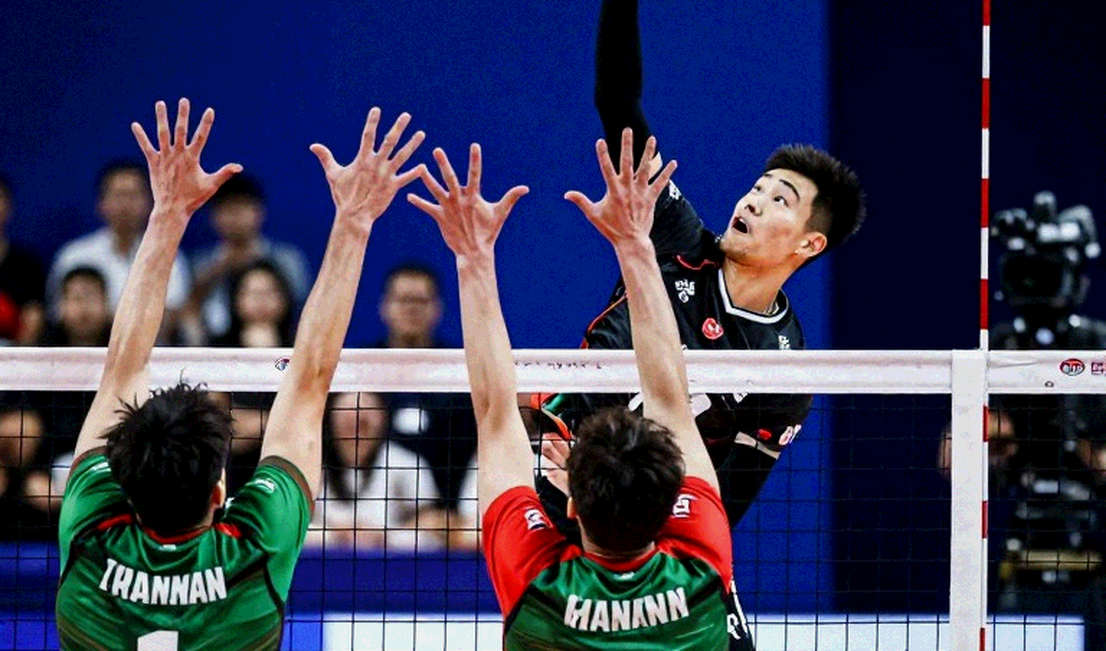
On the court at Asue Arena Osaka, Wolfdogs Nagoya looked close to losing the match entirely after dropping the first two sets. Instead, they turned it around, beating hosts Osaka Bluteon 23-25, 23-25, 25-21, 25-21, 15-8 in a Matchweek 2 fixture of the SV.League Men. The contest lasted two hours and 37 minutes, with 211 points played in total; Nagoya scored 111, Osaka 100. The scoreline alone might suggest a routine comeback, but a closer look at the numbers shows the result was decided not by attacking quality but by error asymmetry and net control.
The timing gives the win added weight. It was Nagoya's first league victory over Osaka since the league began. They had already beaten Osaka 3-2 in a friendly on 11 October, but that result does not count in league terms. Playing at Osaka's home venue made the comeback all the more significant for Nagoya's confidence. Attendance was 7,690, respectable for a large arena but short of a full house.
The first set made clear it would not be easy. Neither side allowed the gap to grow. Osaka edged ahead late and took the set 25-23. The second set followed almost exactly the same pattern: Nagoya fought, but lost the last three or four points and went down 23-25, trailing 0-2. Across those two sets Nagoya scored 46 points to Osaka's 50, a margin of just four — yet a punishing one in terms of sets.
The third set marked the turning point. Nagoya took it 25-21 and re-entered the match. The fourth set produced the identical score, 25-21. Over the final three sets Nagoya scored 65 points to Osaka's 50. A team that had trailed by four points across the first two sets finished 15 points ahead across the last three. That kind of reversal is not simply luck or emotion; it points to a systematic in-match adjustment, although without per-set statistical splits the specific mechanism cannot be identified.
The fifth set belonged entirely to Nagoya, who took the tie-break 15-8. Their tie-break point rate was 65.2 percent (15 of 23) against Osaka's 34.8 percent (8 of 23). The most one-sided passage of the match was the final set, where Osaka's resistance effectively collapsed.
Errors in serving and attacking played the largest role in deciding the outcome. According to the official league match sheet, Nagoya committed only 4 attack errors to Osaka's 10. The gap in service errors was even starker: 18 for Nagoya, 28 for Osaka. That is an average of 5.6 service errors per set for Osaka, extremely high in a five-set match. Counting free points conceded through serve and attack errors combined, Nagoya gave away 22 and Osaka 38. That 16-point gap is larger than the 11-point overall margin — put simply, the gifts decided the match.
Osaka were ahead in attacking efficiency. Their team attack success rate was 57.4 percent against Nagoya's 55.4 percent. But losing while out-hitting the opponent means Osaka could not convert their strength while carrying the weight of their errors. Nagoya were clearly ahead in blocks, 10 to 5. Two blocks per set is considered strong in the men's game; Osaka's one per set is unusually low across five sets. Nagoya also led in aces, 6 to 4, a modest margin, but combined with the block edge it reveals a clear serve-and-block pressure identity.
The standout individual story of Nagoya's win was Bouguerra. He scored 23 points — 22 kills and one block — the highest total in the match. He needed only 33 attack attempts, with 22 kills and just one error, for a 66.7 percent success rate, exceptional for a single match. A caveat is essential when reading this line: it is not clear whether blocked attacks were charged as errors. Under the conservative convention, his efficiency figure would be somewhat lower. The number should therefore be treated as a range rather than a point estimate.
One further detail matters: 8 of Bouguerra's 22 kills came from the back row, meaning 36.4 percent of his kills came from behind the three-metre line. At the top level of men's volleyball, a back-row share above 30 percent for a single outside hitter usually signals one of two things — either the team is deliberately running a pipe or back-row-heavy system, or the team is repeatedly forced into out-of-system situations. With no reception data available, the second possibility cannot be ruled out.
The degree of dependency is also notable. Roughly 33 to 39 percent of Nagoya's attack points came from Bouguerra, a heavy load for one player in a five-set match. That dependency worked in the short term but could become a risk over a long season.
Nagoya's second-highest scorer was Džavoronok with 17 points — 14 kills, two aces and one block. Third was Yamazaki with 12 points, though the composition of his total was not specified. It is reasonable to assume he contributed a meaningful share of Nagoya's 10 team blocks, but that cannot be confirmed.
For Osaka, Kai led with 20 points — 17 kills, two aces and one block. López added 18 and captain Nishida 14. Here an interesting symmetry emerges: the top three scorers on each side totalled exactly 52 points apiece. The match was not won by one team's stars out-scoring the other's; it was won in the auxiliary columns, in error control and at the net.
Tactically, Osaka's serving strategy raises the biggest question. Twenty-eight service errors against just four aces in five sets is a deeply negative risk-return profile. Osaka's ace-to-error ratio was 0.14, against Nagoya's 0.33. A ratio below 0.5 is generally treated as a net-negative serving profile. Even accounting for the tactical value of breaking reception, Osaka effectively gifted more than a set's worth of points.
The positive for Nagoya was error discipline. Only four attack errors is an outstanding figure at the elite level. Eighteen service errors is not low either, but far more tolerable than Osaka's total. With 10 blocks and six aces, Nagoya gradually pulled control of the match towards themselves.
Analysing the tempo yields another data point. Two hours and 37 minutes for 211 points works out at roughly 1.34 points per minute — a slow match. That could indicate long rallies or frequent stoppages, but the conclusion remains speculative, as no rally-length or stoppage data exists.
The data limitations should be stated plainly. There is no reception or perfect-pass data, no dig data, no per-set splits, no positional identification of players, and no injury or coaching information. The head-to-head history is sourced from a betting data aggregator, which carries low reliability. As a result, questions such as whether Nagoya's reception was weak, or how their serving targets changed from the third set, can only be raised as inferences, not established as evidence.
Context matters too. This was Matchweek 2, the very start of a new season. Both teams are still gelling. In that situation, Osaka's 28 service errors could be the product of a single bad night, or of a mispriced tactical calculation. The coming matches will provide the answer.
The broader lesson of the match is that a team can win while trailing in attacking efficiency, provided it controls errors and controls the net. Nagoya did exactly that. They were two percentage points behind Osaka in attack, yet 16 points ahead in the competition to give away free points. Volleyball matches of this kind are a reminder that alongside power and skill, restraint matters just as much.
For Nagoya, this was a first league win over Osaka, achieved from two sets down. A comeback of that shape will strengthen the team's mental framework. For Osaka, it is a hard lesson: a team that leads in attack but gifts the most points will find the path to victory a difficult one.


Related Players
Recommended
A Stage Was Built for Campus Volleyball, Not a Pathway: Indonesia's LVM 20262026-09-26
The Empty Ledger: The Record Nobody Kept for Bangladesh's Women's Volleyball2026-10-14
Equal Ledger on Campus Courts: How Women's Volleyball Entered the Account Book at Indonesia's LVM 20262026-09-26
LVM 2026: 36 Teams, 60 Matches, and a Rulebook Nobody Has Published2026-09-26
Eighteen and Eighteen: Paper Parity and Camera Arithmetic in Indonesia's Campus League2026-09-26
38–36: A 74-Point Set, and the Real Ledger Behind the Fall of Pitt's 58-Match Fortress2026-10-17
Three Cities, 36 Teams, One Question: Is Indonesia's Campus Volleyball League Building Players or Content?2026-09-26
Recommended
Volleyball's New Stadium Is a Streaming Platform: The Ledger Indonesia's LVM 2026 Just Opened in Front of Bangladesh2026-09-26
Three Cities, 36 Teams, 60 Matches: Where MOJI's Liga Voli Mahasiswa 2026 Actually Stands2026-09-26
The Fortress Fell, but the Real Crack Runs Through Babcock's Shoulder2026-10-11
Eighteen and Eighteen: Paper Parity and Camera Arithmetic in Indonesia's Campus League2026-09-26
Equal Ledger on Campus Courts: How Women's Volleyball Entered the Account Book at Indonesia's LVM 20262026-09-26
LVM 2026: 36 Teams, 60 Matches, and a Rulebook Nobody Has Published2026-09-26
Nebraska's No. 1: A 24-Set Streak, 16 Digs a Set, and the Committee's First In-Season Top 162026-10-21